Menu
Menu


As hemato-oncology guidelines evolve rapidly, laboratories face growing pressure to test for more genes and genetic aberrations while maintaining the throughput and turnaround times clinicians need to make timely treatment decisions. For Prof. Schmetterer's team, this meant moving away from a patchwork of fragmented, single-gene assays toward a more comprehensive, NGS-based approach.
In this conversation, Prof. Schmetterer shares why his lab chose to consolidate its molecular workflows with SOPHiA GENETICS, how the transition is freeing up resources for tests like minimal residual disease monitoring, and what he sees as the biggest unmet needs in hematological oncology testing today.
Watch the spotlight:
Could you introduce yourself and your work at the Medical University of Vienna?
My name is Klaus Schmetterer. I'm an MD and PhD, and I head the molecular diagnostics department at the Medical University of Vienna, which is embedded in the General Hospital of Vienna.
My responsibilities are in hemato-oncology. I cover all the molecular diagnostics in these diseases, ranging from acute leukemias like AML and ALL, to the more differentiated lymphomas when we find them in blood or bone marrow, to myelomas. The whole spectrum of hemato-oncology diseases.
Can you give us a sense of the scale of your work?
Since we are a very large tertiary care hospital with a strong focus on hematological diseases, we cover roughly several thousand patient cases per year. These are samples, so the actual patient numbers may be a bit lower, and they range from single-gene tests to whole NGS panels.
As for the bulk of the diseases, we have a focus on myeloid diseases, so we see a lot of AML, MDS, and related conditions. That's where most of our diagnostics is focused.
What are the most significant challenges your lab faces?
Guidelines are evolving very rapidly, and the science in hemato-oncology moves fast and is very well structured, so the guidelines follow it closely.
We need more and more genes, more and more genetic aberrations. Also, because we're a very large hospital, scalability is of course a major issue for us.
We need throughput, but we also need a timely turnaround, which is very important so that we can give clinicians the information they need to make informed decisions, the therapeutic decisions about the patients, in a rather short time.
What drove your decision to move toward a more comprehensive solution?
We were not covering all the relevant genes, and that was the initial point. But from there on, and I realized this even more in the work I've been doing together with SOPHiA GENETICS, I saw that our workflows were far too fragmented, which meant they needed more resources than necessary.
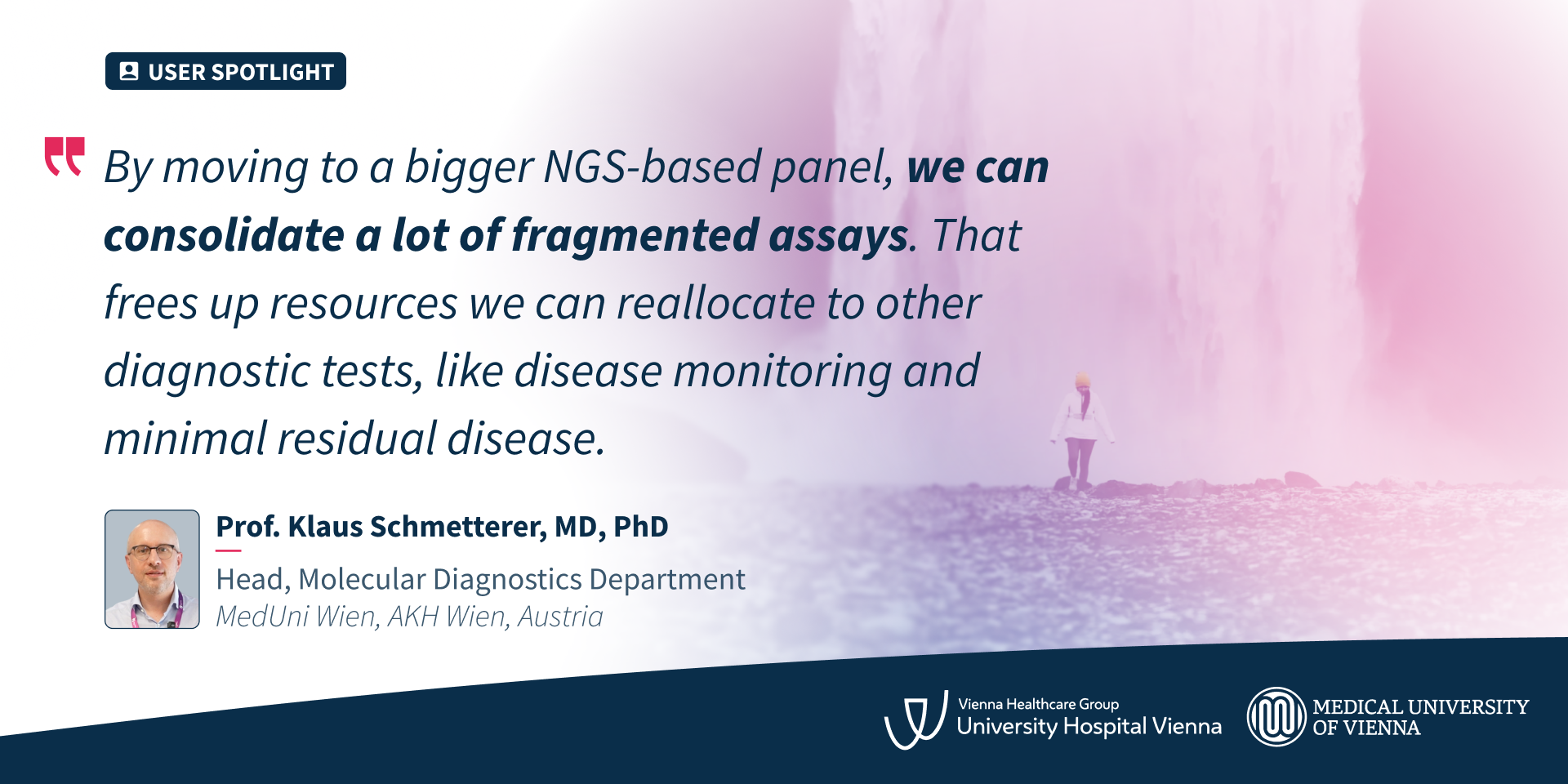
By moving to a bigger NGS-based panel, we can consolidate a lot of these fragmented assays. That frees up resources we can reallocate to other diagnostic tests, like disease monitoring and minimal residual disease, which are also very important but that we don't address sufficiently right now.
You're still in the early stages of this transition, what outcomes are you looking forward to the most?
My impression is a very good one, and I'm very happy that we chose SOPHiA GENETICS as a partner. It's a very professional environment. I was coming into this whole field very new and had to take over from scratch, and from the beginning the interaction with SOPHiA GENETICS was professional, helpful, supportive, and well structured, which made it easier for me to transition into this new role.
I'm looking forward to being able to cover more breadth, both in what we can find in the diseases we already cover, like the myeloid diseases, and by extending the spectrum to the lymphoid side, which we entered at the same time. As I mentioned, I can consolidate workflows in our laboratory and then use those resources for other necessary tests, such as monitoring.
What do you see as the biggest unmet need in hematological oncology testing?
We need to address the patient more as a whole. Genomics data will be one part, but also data from other diagnostic branches, integrating it all into one big picture that allows us to stratify the patient even better, and to see whether he or she will benefit from a given treatment or not.
I also think that, as fast as hemato-oncology is evolving, we'll see a huge number of novel treatment options in the coming years. We'll need the genetic background of the disease, but probably also of the tumor environment. That's something that isn't addressed in most diagnostic workflows right now, and its key to giving patients the best treatment options.
In this spotlight, Prof. Schmetterer covers why his team made the move toward comprehensive testing. The full on-demand webinar goes further, showing how a patchwork of single-gene assays became one integrated workflow, delivering 12 times more coverage for a comparable cost, and freeing up resources for tests like MRD monitoring.
The opinions expressed are those of the speaker and may not represent the opinions of SOPHiA GENETICS. Any use of SOPHiA GENETICS products described may not have been cleared or approved by Regulatory Authorities. SOPHiA DDM™ Solutions are For Research Use Only unless otherwise specified.
SOPHiA GENETICS products are for Research Use Only and not for use in diagnostic procedures unless specified otherwise.
SOPHiA DDM™ Dx Hereditary Cancer Solution, SOPHiA DDM™ Dx RNAtarget Oncology Solution and SOPHiA DDM™ Dx Homologous Recombination Deficiency Solution are available as CE-IVD products for In Vitro Diagnostic Use in the European Economic Area (EEA), the United Kingdom and Switzerland. SOPHiA DDM™ Dx Myeloid Solution and SOPHiA DDM™ Dx Solid Tumor Solution are available as CE-IVD products for In Vitro Diagnostic Use in the EEA, the United Kingdom, Switzerland, and Israel. Information about products that may or may not be available in different countries and if applicable, may or may not have received approval or market clearance by a governmental regulatory body for different indications for use. Please contact us to obtain the appropriate product information for your country of residence.
All third-party trademarks listed by SOPHiA GENETICS remain the property of their respective owners. Unless specifically identified as such, SOPHiA GENETICS’ use of third-party trademarks does not indicate any relationship, sponsorship, or endorsement between SOPHiA GENETICS and the owners of these trademarks. Any references by SOPHiA GENETICS to third-party trademarks is to identify the corresponding third-party goods and/or services and shall be considered nominative fair use under the trademark law.