Menu
Menu


In India, SOPHiA DDM™ Hereditary Cancer Solutions are distributed for Research Use Only (RUO) and are not registered as medical devices or diagnostic tools; RUO results must not be used for clinical diagnosis, patient management, or therapeutic decision-making.
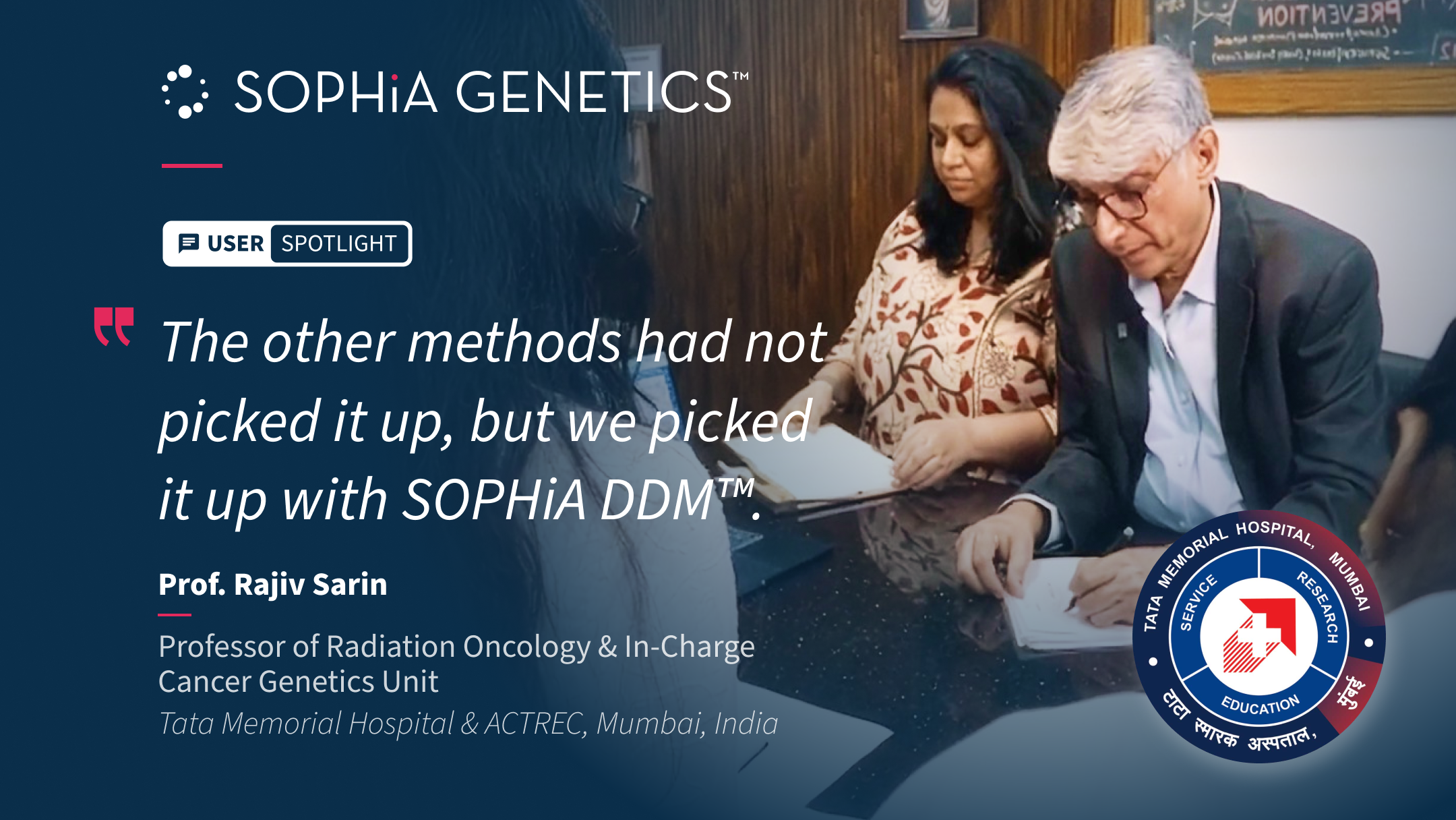
Inside South Asia's Largest Cancer Center: Prof. Rajiv Sarin on Building a Genomics Program That Doesn't Miss
For almost three decades, Prof. Rajiv Sarin has been at the center of cancer genetics at Tata Memorial Hospital, the largest and oldest comprehensive cancer center in South Asia, now expanded to nine centers across India. As a Clinician Scientist who established both the Cancer Genetics Clinic and its lab, he's watched genetic testing move from a niche offering for high-risk families to a standard part of cancer care.
We sat down with Dr Sarin at ACTREC, Tata Memorial to talk about that shift, and what changed when his lab brought SOPHiA DDM™ in-house.
Genomics has quietly become mainstream. When Dr Sarin started, genetic testing was reserved for those with a strong family history. But analytical analyses at Tata Memorial found that today, regardless of family history, germline mutations are found in roughly 1 in 6 to 1 in 5 cases.
A successful implementation during the pandemic. Tata's SOPHiA DDM™ implementation began during COVID, so without the usual on-site training visit. Dr Sarin's approach: follow the manual exactly, resist the instinct to "improve" the workflow. The result: 200-250 test runs without a single technical failure. He talks candidly about what pushed him toward SOPHiA DDM™ in the first place, and it centers on one hard requirement: no false negatives, and a false positive rate close to zero.
Addressing the PMS2 problem. One of the most compelling parts of the conversation is Dr Sarin's account of variants in PMS2, a gene out of scope for many labs because of its tricky pseudogene, PMS2CL. Tata Memorial has historically analyzed PMS2 variants using long-range PCR; here, Dr Sarin describes analytical concordance across different approaches, including NGS using SOPHiA DDM™.
A positive finding. Dr Sarin shares a complex test case: a subject with multiple primary cancers who had already tested negative at two other accredited labs. Re-run on SOPHiA DDM™, a positive result was obtained.
Numbers worth noting. Tata's lab has now run over 13-14,000 samples on SOPHiA DDM™, including 5,000 hereditary cancer panels in the last year alone, with reports delivered within ten days of sample receipt. Dr Sarin also speaks frankly about his initial hesitation moving to the new generation SOPHiA DDM™ Platform and how he felt after using it.
Dr Sarin closes with straightforward advice for any lab considering SOPHiA DDM™, based on nearly six years of daily use.
Watch the full interview to hear Dr Sarin walk through the PMS2 story in his own words, the real test case in full detail, and what "good enough for 2026" means to someone who has spent thirty years trying to make sure nothing gets missed.
SOPHiA GENETICS products are for Research Use Only and not for use in diagnostic procedures unless specified otherwise.
SOPHiA DDM™ Dx Hereditary Cancer Solution, SOPHiA DDM™ Dx RNAtarget Oncology Solution and SOPHiA DDM™ Dx Homologous Recombination Deficiency Solution are available as CE-IVD products for In Vitro Diagnostic Use in the European Economic Area (EEA), the United Kingdom and Switzerland. SOPHiA DDM™ Dx Myeloid Solution and SOPHiA DDM™ Dx Solid Tumor Solution are available as CE-IVD products for In Vitro Diagnostic Use in the EEA, the United Kingdom, Switzerland, and Israel. Information about products that may or may not be available in different countries and if applicable, may or may not have received approval or market clearance by a governmental regulatory body for different indications for use. Please contact us to obtain the appropriate product information for your country of residence.
All third-party trademarks listed by SOPHiA GENETICS remain the property of their respective owners. Unless specifically identified as such, SOPHiA GENETICS’ use of third-party trademarks does not indicate any relationship, sponsorship, or endorsement between SOPHiA GENETICS and the owners of these trademarks. Any references by SOPHiA GENETICS to third-party trademarks is to identify the corresponding third-party goods and/or services and shall be considered nominative fair use under the trademark law.