Menu
Menu


This article reflects perspectives shared during a panel discussion at the SOPHiA GENETICS Global Precision Medicine Forum, held at ASCO 2026.
Precision medicine is advancing at a pace that would have seemed unlikely not long ago. New biomarkers keep emerging, new targeted therapies are reaching patients who once had few or no options, and with each advance, therapies are becoming increasingly tailored to smaller, more defined patient populations. As precision medicine evolves, so does the need for robust, scalable diagnostic testing that can accurately identify eligible patients wherever they are.
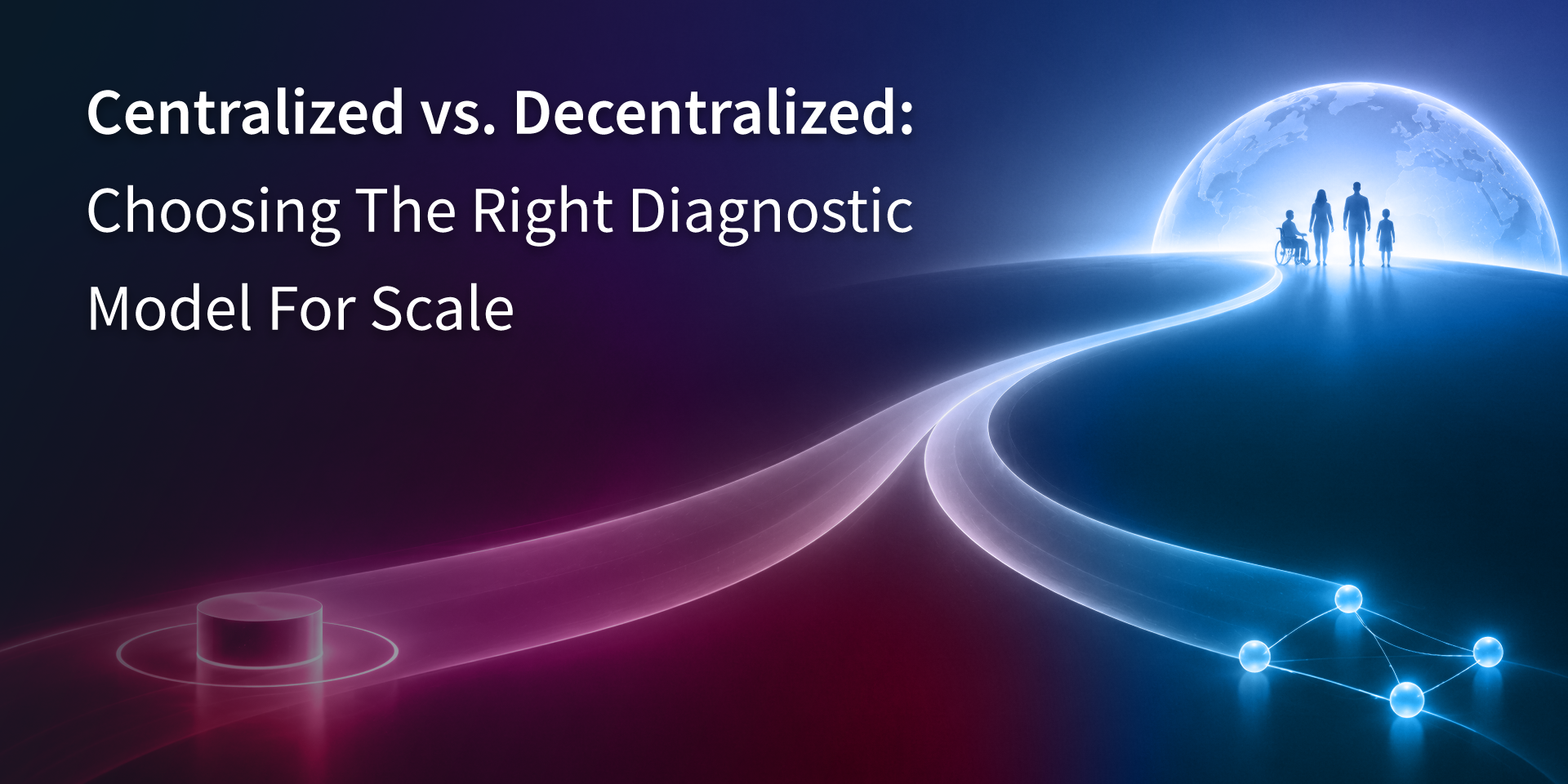
Yet developing and validating the right test is only one part of the challenge. The real bottleneck is ensuring that test reaches patients at scale. And delivering diagnostic testing across diverse healthcare systems raises a fundamental question: should molecular testing be centralized in specialized laboratories, decentralized to local testing sites, or delivered through a combination of both?
Different markets, different disease areas, and different levels of infrastructure maturity all point toward different approaches. A recent conversation among precision medicine leaders from healthcare institutions, diagnostics companies, and top pharmaceutical organizations made one thing clear: this isn’t a debate to be won. It’s a strategy to be designed, market-by-market, to maximize patient access.
Most patients want to be tested close to home, near their family, their own doctor, and their everyday life. They shouldn’t have to travel to a tertiary center for a biopsy, a sequencing test, or a follow-up monitoring assay. This is perhaps the strongest argument for decentralization: enabling local hospitals to deliver advanced molecular testing wherever possible.
The benefits go beyond convenience. Bringing testing into local and regional laboratories doesn’t just shorten turnaround time. It also places expertise and ownership directly into the hands of the clinicians treating patients, while strengthening local healthcare systems in the process.
Perhaps most importantly, decentralization helps address one of the fundamental challenges in healthcare: equitable access. Accurate, timely diagnostic testing should be available to all patients, not only those who live near major medical centres. Enabling advanced testing in local settings is an important step towards closing that gap.
Advances in sample acquisition, sequencing technology, and cloud-based data architecture mean that sophisticated molecular assays no longer need to be performed exclusively in highly specialized reference laboratories. As these technologies continue to mature, decentralization is becoming increasingly feasible across a broader range of healthcare settings.
Decentralization has clear advantages, but it also has limits. Running advanced NGS assays requires more than sophisticated equipment; it demands deep technical expertise and confidence in interpreting the increasingly complex genomic data it produces. For many markets, centralized models remain the more practical way to launch a new assay, validate it rigorously, and establish quality before wider global deployment. Centralized laboratories also provide built-in infrastructure, quality oversight, operational excellence, and backup capacity that many local sites can’t replicate on their own yet (Table 1).
| Centralized model | Decentralized model | |
|---|---|---|
| Primary Objective | Assay validation, regulatory readiness, and quality control | Broad patient access and local routine clinical testing |
| Main Strengths |
|
|
| Works Best When | Specialized expertise is limited or regulatory requirements demand central testing | Qualified laboratories and standardized processes are already established |
| Key Challenge | Sample logistics and broad patient access | Maintaining quality consistency across distributed sites |
Table 1. Key strengths and challenges of centralized and decentralized models.
Neither approach is inherently right or wrong. Each serves a distinct purpose, shaped by the laboratory expertise, the maturity of the healthcare system, the regulatory environment, and the stage of the diagnostic test lifecycle.
Every market is unique with its own regulatory framework, data residency requirements, and constraints on where samples and patient data can travel. Yet, global pharmaceutical companies cannot optimize for a single market. Their challenge is to design a diagnostic strategy that can identify every eligible patient, while adapting to the realities of each healthcare system.
Those realities vary considerably. Some countries have mature reference laboratory networks, integrated healthcare systems, and the expertise needed to support centralized testing. Others, particularly lower- and middle-income countries, have limited centralized laboratory infrastructure, making decentralized testing the most practical way to expand patient access.
In these settings, however, decentralization often works best paired with centralized oversight to ensure consistent quality, standardized workflows, and reliable results. This is where hub-and-spoke models have gained traction, combining central expertise with a network of local testing sites operating under shared protocols.
Across all of these scenarios, success rarely comes from choosing one model in isolation. Instead, it comes from designing a testing strategy that aligns with each market’s infrastructure, regulatory environment, and clinical needs. That thinking is increasingly shaping the next generation of diagnostic deployment partnerships.
This industry mindset shift reflects a broader recognition that centralized and decentralized testing are not competing models, but different components of the same access strategy.
From a pharma perspective, centralized models remain critical for assay validation and regulatory submissions and approval. Once a therapy reaches the market, however, the priority shifts to ensuring patients can access testing close to where they receive care. That requires a decentralized network capable of delivering high-quality tests at scale. Rather than replacing one another, centralized and decentralized models serve different purposes at different stages of a therapy’s lifecycle.
One example discussed by the experts was the hybrid companion diagnostic (CDx) model developed by SOPHiA GENETICS and brought to life through strategic partnerships with diagnostic companies, such as Myriad Genetics. This partnership combines centralized assay validation with AI-powered analytics and a decentralized distribution model designed to support both clinical trial assays (CTA) and CDx. The assay is validated in a central laboratory where regulation still demands it, then is deployed as a kit-based solution that enables local laboratories to perform testing once the therapy reaches the market. In this model, the central laboratory continues to play a vital first role by supporting regulatory approval, and then by enabling broader patient access through decentralized testing once a therapy reaches the market.
None of this works in isolation. Closing the access gap takes collaboration across the entire precision medicine ecosystem. Academic centers, diagnostic companies, pharmaceutical organizations, regulators, and healthcare providers all have a role to play in raising the bar on quality standards, sharing expertise across borders, and building the education and infrastructure that decentralized testing depends on.
Ultimately, expanding access to precision medicine isn’t about choosing between centralized and decentralized testing. It’s about building the right ecosystem that combines scientific rigor, operational flexibility, and collaboration to ensure every patient, no matter where they happen to be, has the same standard of care and can benefit from precision medicine.
Disclaimer
The opinions expressed by the panelists are their own and may not represent the opinions of SOPHiA GENETICS and the companies they work for.
SOPHiA GENETICS products are for Research Use Only and not for use in diagnostic procedures unless specified otherwise.
SOPHiA DDM™ Dx Hereditary Cancer Solution, SOPHiA DDM™ Dx RNAtarget Oncology Solution and SOPHiA DDM™ Dx Homologous Recombination Deficiency Solution are available as CE-IVD products for In Vitro Diagnostic Use in the European Economic Area (EEA), the United Kingdom and Switzerland. SOPHiA DDM™ Dx Myeloid Solution and SOPHiA DDM™ Dx Solid Tumor Solution are available as CE-IVD products for In Vitro Diagnostic Use in the EEA, the United Kingdom, Switzerland, and Israel. Information about products that may or may not be available in different countries and if applicable, may or may not have received approval or market clearance by a governmental regulatory body for different indications for use. Please contact us to obtain the appropriate product information for your country of residence.
All third-party trademarks listed by SOPHiA GENETICS remain the property of their respective owners. Unless specifically identified as such, SOPHiA GENETICS’ use of third-party trademarks does not indicate any relationship, sponsorship, or endorsement between SOPHiA GENETICS and the owners of these trademarks. Any references by SOPHiA GENETICS to third-party trademarks is to identify the corresponding third-party goods and/or services and shall be considered nominative fair use under the trademark law.