Menu
Menu


When TomaLab set out to modernize its lab, the goal wasn't just to adopt new technology, it was to improve efficiency and give its clinicians more confidence in the results. Based in northern Italy, TomaLab is a private reference center for molecular genetics and one of the country's most established names in the field. In this interview, CEO Eng. Rosario Bifulco, Sales Director Annamaria Galietta, and Dr. Francesca Dulcetti, Laboratory Director, walk us through what it took to consolidate their genomic workflows onto SOPHiA DDM™ and Element Biosciences' AVITI™ platform, and what's changed since.
That migration touched several parts of TomaLab's testing menu, including the SOPHiA DDM™ Hereditary Cancer Solution, Whole Exome Solution, and Clinical Exome Solution, with plans already underway to extend the same approach to reproductive genetics and somatic oncology testing.
Watch the full interview below:
Read the full transcript below:
Eng. Rosario Bifulco – Legal Representative and CEO
Where does TomaLab stand in the Italian healthcare system, and what challenges come with managing genomic data?
Tomalab is one of the leading names in Italian healthcare when it comes to genetics. We were the first lab to develop prenatal diagnosis, many years ago.
The challenges around genetic data are, naturally, data analysis, the sheer volume of data to manage, and also governance and data confidentiality, in other words, data security.
What are TomaLab’s priorities over the next three to five years? And can the partnership with SOPHiA GENETICS support these goals?
When it comes to our offering, we focus on three main areas. One is oncology, where we've been active for a few years now. Another important area for us is rare diseases, and finally, of course, we haven't forgotten our roots, reproductive genetics.
As for geographic growth, alongside expanding further across Italy, in the country's various regions, we're also growing internationally, launching projects in partnership, or sometimes on our own, in selected markets, particularly in the Balkans.
SOPHiA GENETICS is important, of course, for its contribution to data analysis. The work it's doing with artificial intelligence is essential in the world of genetics, given all the data we're able to generate and need to analyze, so, it's essential from that point of view.
It's also very important for its ability to bring us into an international network of laboratories, letting us compare notes with other established labs around the world, and that naturally helps build the know-how and scientific rigor of our lab.
Annamaria Galietta – Sales Director – Strategic Marketing
What led TomaLab to adopt SOPHiA GENETICS and Element Biosciences technologies?
TomaLab decided to reorganize its workflow, particularly in the lab, both on the technological side, using Element Biosciences AVITI™, and the New Generation of SOPHiA DDM™ Platform for data analysis. This gave us an end-to-end workflow that let us optimize both our human resources within the lab, and achieve cost savings, over the medium-to-long terms, across our entire production flow.
What are the major benefits of this integrated workflow?
The benefits we've gained as a lab are numerous. The first is really on the operational side within the lab, where we've optimized the workflow by linking pre-analytics, analytics, and post-analytics. This has let us save 10% of our team's time, allowing for greater focus on reporting the data.
From an economic standpoint, TomaLab has seen a huge advantage in cost savings on reagents. In fact, compared to the previous technology used in the lab, we've found that we've managed to cut costs by 30-40%.
Having covered both the operational and economic advantages, we can say with certainty that productivity within TomaLab has risen by 10%.
What has been the impact of this workflow for you and your clients?
Technological innovation, optimizing our workflow, and above all, increasing our internal expertise has given TomaLab real scalability when it comes to the clinical diagnostic offering, we provide to our clinicians. This has allowed us to give our clients visibility into what happens in the lab, right through to the final results, so, it has really let us guide them from start to finish.
Dr. Francesca Dulcetti – Director, Laboratory of Medical Genetics
What's already running on the new workflow, and what's next?
I have to say that the migration to the new Element platform was much faster and more comprehensive than we had initially anticipated. In fact, in just three weeks, we managed to transfer 95% of our core NGS-based medical genetics business.
We still have 5% of our business left to transfer. We haven’t done so yet simply because these are niche tests, and over the coming months we need to complete all the analytical validations required to be confident in the results.
Looking ahead, our goal is to extend the same approach to other areas of our lab, particularly reproductive genetics, while also considering some somatic oncology applications, such as those focused on liquid biopsy, which was developed by SOPHiA GENETICS in collaboration with Memorial Sloan Kettering Cancer Center.
How has the new workflow changed your daily operations?
Without doubt, the change that's had the biggest impact is a qualitative one, an increase in average coverage. That increase in average coverage also allows us to pick up variants in certain regions that, with the previous workflow, we sometimes struggled to identify well, and on top of that, it also gives our reports an extra layer of reliability.
How easy was it to integrate this new workflow into daily routine?
As a lab that works to ISO 15189 standards, especially for our NGS processes, the adoption made clear that this workflow was designed around the lab’s needs, not the other way around.
Which tells you the team is used to working to very high-quality standards. The other thing I'd say is that, at this stage, the support we received from the whole SOPHiA GENETICS team in transferring, as I mentioned, most of our medical genetics workflow to NGS made things much simpler, especially compared to before, because there was real synergy between the SOPHiA DDM™ interpretive team and Element's technical team.
In one sentence, how would you describe the value of this workflow to your lab?
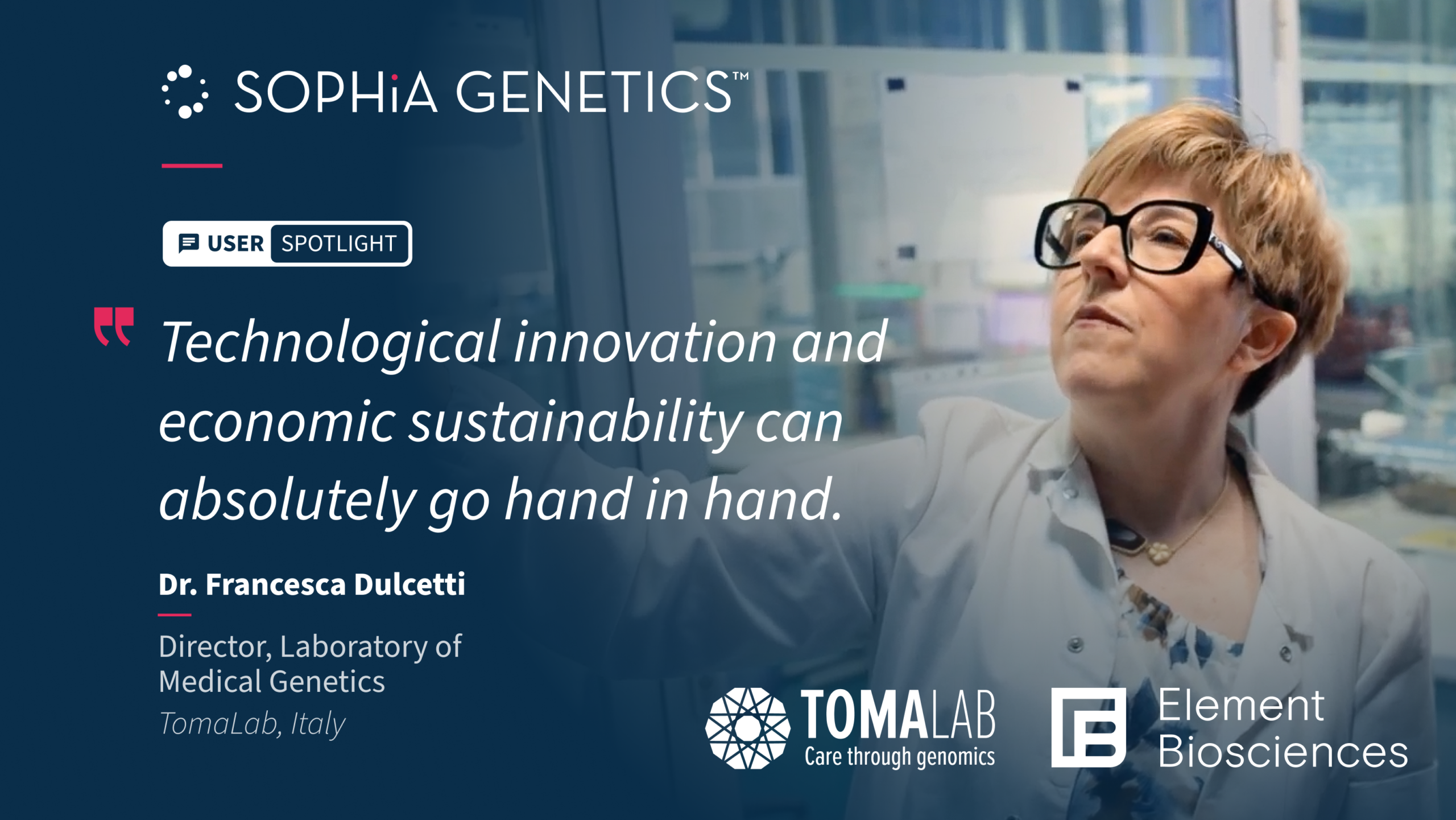
Definitely, the first phrase that comes to mind is the proof that, in practice, technological innovation and economic sustainability can absolutely go hand in hand.
Interested in combining SOPHiA DDM™ with Element Biosciences' sequencing platform in your lab? Talk to our team.
The opinions expressed are those of the speakers and may not represent the opinions of SOPHiA GENETICS. Any use of SOPHiA GENETICS products described may not have been cleared or approved by Regulatory Authorities. SOPHiA DDM™ is for Research Use Only (RUO); RUO results must not be used for clinical diagnosis or patient management without further validation by the laboratory.
SOPHiA GENETICS products are for Research Use Only and not for use in diagnostic procedures unless specified otherwise.
SOPHiA DDM™ Dx Hereditary Cancer Solution, SOPHiA DDM™ Dx RNAtarget Oncology Solution and SOPHiA DDM™ Dx Homologous Recombination Deficiency Solution are available as CE-IVD products for In Vitro Diagnostic Use in the European Economic Area (EEA), the United Kingdom and Switzerland. SOPHiA DDM™ Dx Myeloid Solution and SOPHiA DDM™ Dx Solid Tumor Solution are available as CE-IVD products for In Vitro Diagnostic Use in the EEA, the United Kingdom, Switzerland, and Israel. Information about products that may or may not be available in different countries and if applicable, may or may not have received approval or market clearance by a governmental regulatory body for different indications for use. Please contact us to obtain the appropriate product information for your country of residence.
All third-party trademarks listed by SOPHiA GENETICS remain the property of their respective owners. Unless specifically identified as such, SOPHiA GENETICS’ use of third-party trademarks does not indicate any relationship, sponsorship, or endorsement between SOPHiA GENETICS and the owners of these trademarks. Any references by SOPHiA GENETICS to third-party trademarks is to identify the corresponding third-party goods and/or services and shall be considered nominative fair use under the trademark law.