Menu
Menu


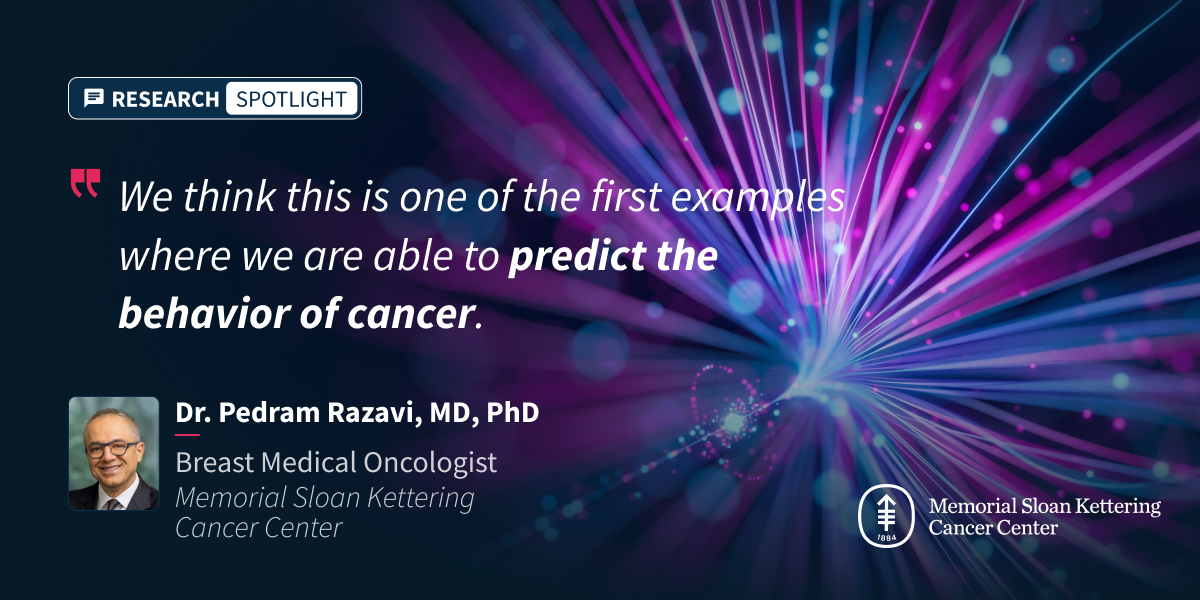
Management of resistance in breast cancer has traditionally been reactive, with the mechanisms of resistance only identified after a tumor has progressed. In this interview, Dr. Pedram Razavi, Breast Medical Oncologist at Memorial Sloan Kettering Cancer Center (MSK), discusses research efforts aimed at predicting how tumors will become resistant to treatment.
In a study published in Nature1, Dr. Razavi’s team analyzed both inherited and tumor genomic data using MSK-IMPACT®. They found that tumors in patients with inherited BRCA2 mutations are prone to losing the protective gene RB1, a known route to CDK4/6 inhibitor resistance in HR+/HER2- metastatic breast cancer. Two factors compound each other: these tumors often start with just one working copy of RB1, and ongoing homologous recombination deficiency (HRD) makes it easier to lose the other under treatment.
The study’s findings have implications for first-line therapy in metastatic breast cancer, now being investigated in the Phase III EvoPAR-Breast01 trial.
Watch the spotlight to learn more:
We thank Dr. Razavi for sharing his time and insights.
SOPHiA GENETICS collaborated with MSK to decentralize their advanced precision oncology assays for tissue and liquid biopsy, MSK-IMPACT® and MSK-ACCESS®. The solutions enable laboratories to perform matched tumor-normal sequencing in-house, streamlining the analysis of both germline and somatic mutations in a single workflow.
Contact us to learn more about how MSK-IMPACT® Flex and MSK-ACCESS® powered with SOPHiA DDM™ can enhance your oncology research.
Hi, I'm Pedram Razavi. I'm a Breast Medical Oncologist at Memorial Sloan Kettering Cancer Center in New York. I lead the Translational Program for Breast Cancer here, and I also lead an institution-wide program called the Translational Oncology Partnership Program, which focuses on large-scale translational studies in collaboration with industry and academic partners.
What I'd like to talk about today is the program we have put together at MSK on predicting the behavior of cancer under therapeutic pressure.
So far, we have been very reactive. We wait for the tumor to progress and for resistant clones to evolve under therapeutic pressure. We understand the mechanism of resistance, and then we go after it if it is actionable. By doing so, we have had tremendous success, and multiple drugs targeting these actionable alterations have been developed and approved for breast cancer.
But we noticed that there is a great deal of convergent, parallel evolution in breast cancer, with many different clones going after the same mechanism of resistance under therapeutic pressure. We learned this from our multi-regional biopsy studies. That prompted us to start thinking: can we predict the mechanism of resistance under therapeutic pressure, and by doing so shift the paradigm from being reactive to being proactive in the management of cancer?
We started by thinking about germline-somatic interactions. More than 99.99% of the tumor genome is the same as the genome of the normal cells. The tumor develops genomic alterations that give it an advantage over normal cells, but the majority of the genome is identical. We thought that looking at high-penetrance pathogenic germline alterations would be a good starting point for understanding how the germline shapes the behavior of cancer under therapeutic pressure.
We assembled a large cohort of patients enrolled in our Translational Program for breast cancer. All of them had germline-somatic analysis of their tumors using the MSK-IMPACT® assay. The germline data was anonymized, and we performed an enrichment analysis to see which genes and mutations were enriched in patients with high-penetrance germline alterations, such as BRCA1, BRCA2 and PALB2, as well as intermediate-penetrance ones such as CHEK2.
What struck us from the very beginning was the divergence between BRCA1 and BRCA2. It is well known that P53 alterations are enriched in BRCA-associated tumors. What we found was that BRCA1 tumors were enriched for P53 mutations, while BRCA2 tumors were not. To our surprise, RB1 loss-of-function mutations were highly enriched in BRCA2 tumors, while they were depleted in BRCA1 tumors.
This was the opposite of what we expected, because RB1 loss-of-function mutations are usually seen in triple-negative breast cancer, which is also where we see germline BRCA1 mutations. When we looked into it, we found that the majority of these RB1 loss-of-function mutations in BRCA2 carriers were in ER-positive patients, and almost all of them were acquired under therapeutic pressure.
The role of RB1 in CDK4/6 inhibitor resistance is very well known. So we examined RB1 loss-of-function mutations and germline BRCA2 mutations as predictors of outcomes for patients receiving CDK4/6 inhibitors. We found that HRD and BRCA2 were strongly associated with worse outcomes on CDK4/6 inhibitors, both in the first-line and in later-line settings.
Then we asked why germline BRCA2 tumors are more likely to develop RB1 loss-of-function mutations than germline wild-type tumors. At least part of the answer came quickly: RB1 and BRCA2 are both located on the long arm of chromosome 13, relatively close to each other. In germline BRCA2 tumors, as part of tumorigenesis, the tumor loses one copy of BRCA2, and in doing so it also loses one copy of RB1. The tumor is left with a single copy of RB1, a state called hemizygosity, or loss of heterozygosity.
We reasoned that having just one copy of RB1 at baseline could lower the evolutionary threshold for the tumor to lose RB1 function under therapeutic pressure, which is an important mechanism of resistance to CDK4/6 inhibitors.
And that is indeed what we found. RB1 loss-of-function mutations were almost exclusively seen in tumors that had only one copy of RB1 at baseline. HRD and other mutagenic processes also seemed to contribute. So, it is not only the copy number profile of the tumor, with a single copy of RB1, that leads to RB1 loss-of-function mutations under therapeutic pressure. Mutagenic processes like HRD also promote the development of these mutations.
This is, in a way, a reverse of Knudson's two-hit hypothesis. In the Knudson hypothesis, an infant is born with one dysfunctional copy of RB1 and then undergoes loss of heterozygosity, losing the functional copy. That leads to complete RB1 loss and the development of retinoblastoma. In our scenario, loss of heterozygosity is the first hit, and the mutation that arises under therapeutic pressure is the second hit.
RB1 loss-of-function mutations are not very common. They occur in less than 0.5% of CDK4/6-inhibitor-naive, ER-positive breast cancers, and only around 10% of tumors develop an RB1 loss-of-function mutation once exposed to these drugs. But we found that hemizygous tumors, those with only one functional copy of RB1, are far more likely to develop these mutations under therapeutic pressure. Other mutagenic processes, such as HRD and, to some extent, APOBEC, can also promote these mutations and increase the likelihood of this mechanism of resistance.
We expanded this analysis to other tumor suppressors. Interestingly, in tumors that are HRD for reasons other than germline BRCA2, other tumor suppressors associated with CDK4/6 inhibitor resistance were far more likely to be altered, but RB1 was not one of them. That tells us the copy number and the location of RB1 relative to germline BRCA2 are very important to the biology here.
So what are the implications? We think this is probably one of the first examples where we are able to predict the behavior of cancer, and I believe there is a huge opportunity to identify which tumors have the potential to develop particular mechanisms of resistance under therapeutic pressure.
Tumors are not omnipotent. They cannot develop every mechanism of resistance. There are many mechanisms of resistance to any given therapy, but each tumor, because of its germline and somatic constraints and its own tendencies, favors one or two of them. They are more like one- or two-trick ponies. We can predict those mechanisms, and we can potentially block their development, in which case many of these tumors may not survive. That is our hypothesis, and we saw an opportunity to put it to the clinical test.
We thought about a clinical trial for patients who are HRD and receive CDK4/6 inhibitors in the first line, which is now the standard of care. We reasoned that these patients might respond very well to PARP inhibitors. When we looked at our data, we saw that the majority of these patients, even when they received PARP inhibitors multiple lines after CDK4/6 inhibitors, still had better outcomes on the PARP inhibitor, in both progression-free survival and tumor response, than they had on first-line CDK4/6 inhibitors. That is the opposite of what you would expect, since patients usually do much better in the first-line setting. So we thought this could be a way to change the paradigm and give these patients PARP inhibitors first.
We also ran preclinical experiments in the lab to study how these germline mutations shape the behavior of tumors under therapeutic pressure. In multiple PDX models, germline BRCA2 tumors developed RB1 loss-of-function mutations to become resistant to CDK4/6 inhibitors.
We also had a patient in our autopsy series for whom we had multiple PDXs from postmortem samples. During her treatment she developed an RB1 loss-of-function mutation, but lost it when she received PARP inhibitors and chemotherapy. In the autopsy samples there was no RB1 loss-of-function mutation. However, one of the tumors, and one of the PDXs, had a reversion mutation that corrected the reading frame of BRCA2, making the tumor homologous recombination repair proficient. Another tumor in the lung, in very close proximity, did not have the reversion mutation.
That gave us a unique opportunity to test our hypothesis, with one model with the reversion mutation and one without. We found that the tumor with the reversion mutation became sensitive to CDK4/6 inhibitors. The tumor without it, which was still HRD, remained resistant to CDK4/6 inhibitors and had developed an RB1 loss-of-function mutation.
This told us that if we change the paradigm and treat patients with PARP inhibition first, it could produce not only better outcomes in the first-line setting. By developing reversion mutations and correcting the HRD in many of these tumors, patients may also do better on subsequent CDK4/6 inhibitors.
That was the hypothesis behind the EvoPAR-Breast01 clinical trial. It is a Phase III global registration study of saruparib, a PARP1-selective inhibitor, plus camizestrant, an oral SERD. It is compared against camizestrant plus a CDK4/6 inhibitor, and the main control arm is standard-of-care CDK4/6 inhibition plus endocrine therapy. The study is now open and has enrolled very well globally.
We will test this hypothesis in the clinical setting for the first time. If we can show that this changes the way these tumors behave, then in my opinion it will be one of the first examples where predictions of how tumors behave under therapeutic pressure are used to change the treatment paradigm for patients.The transcript has been lightly edited for clarity.
SOPHiA GENETICS products are for Research Use Only (RUO), unless specified otherwise. RUO results must not be used for clinical diagnosis or patient management.
SOPHiA GENETICS products are for Research Use Only and not for use in diagnostic procedures unless specified otherwise.
SOPHiA DDM™ Dx Hereditary Cancer Solution, SOPHiA DDM™ Dx RNAtarget Oncology Solution and SOPHiA DDM™ Dx Homologous Recombination Deficiency Solution are available as CE-IVD products for In Vitro Diagnostic Use in the European Economic Area (EEA), the United Kingdom and Switzerland. SOPHiA DDM™ Dx Myeloid Solution and SOPHiA DDM™ Dx Solid Tumor Solution are available as CE-IVD products for In Vitro Diagnostic Use in the EEA, the United Kingdom, Switzerland, and Israel. Information about products that may or may not be available in different countries and if applicable, may or may not have received approval or market clearance by a governmental regulatory body for different indications for use. Please contact us to obtain the appropriate product information for your country of residence.
All third-party trademarks listed by SOPHiA GENETICS remain the property of their respective owners. Unless specifically identified as such, SOPHiA GENETICS’ use of third-party trademarks does not indicate any relationship, sponsorship, or endorsement between SOPHiA GENETICS and the owners of these trademarks. Any references by SOPHiA GENETICS to third-party trademarks is to identify the corresponding third-party goods and/or services and shall be considered nominative fair use under the trademark law.