Menu
Menu


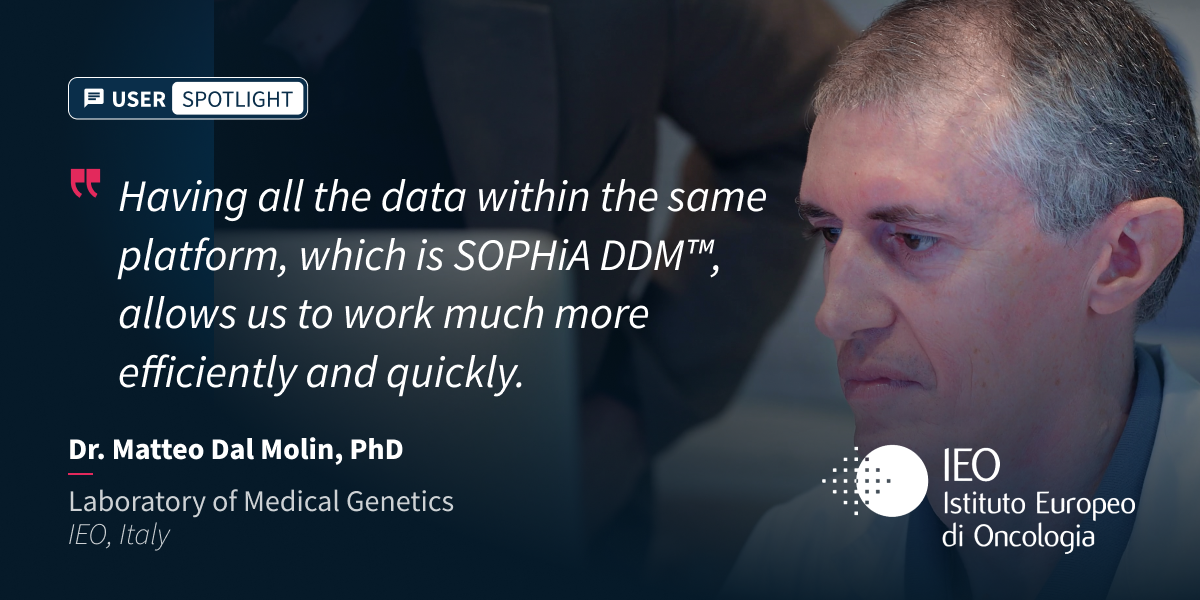
The European Institute of Oncology (IEO) is the largest comprehensive cancer center in Italy and one of the largest in Europe, testing several thousand patients every year.
For this spotlight, we spoke with three members of the Laboratory of Medical Genetics, Cytogenetics and Molecular Genetics about how SOPHiA DDM™ has changed their germline workflow:
We also spoke with Dr. Francesco Bertolini, MD, PhD, Head of the Laboratory Division of Clinical Hematology-Oncology, about cancer interception: acting on the earliest signs of disease progression, before a pre-malignant condition becomes aggressive.
Watch the full interview below:
A successful case of workflow consolidation. The team used to combine NGS for SNVs and Indels with MLPA for CNVs. With the SOPHiA DDM™ Hereditary Cancer Solution v2, they detect all three variant types at once, saving time and cost. Dr. Dal Molin adds that having analysis and classification in a single environment lets the team go from FASTQ to results in about two hours.
Nearly half the review time. Dr. Dal Molin explains that the biggest improvement is a simpler analysis workflow. Custom filters remove benign and likely benign variants from review, virtual panels limit analysis to a specific set of genes, and dynamic panels narrow the focus to a single gene. The rest of the data stays on the platform in case the team needs to go back to it. Classification and reporting that used to take about two hours now take almost half that time.
Interpreting complex variants. Dr. Marino explains how the platform helps resolve variants with annotation problems. In PMS2, for example, a pseudogene (PMS2CL) shares highly homologous regions with the gene, so SOPHiA DDM™ flags variants there for verification. Moreover, the ability to record custom classifications for novel variants streamlines review, as they are flagged whenever they reappear in later samples.
A complex predisposition finding with clear actionability. A young woman with bilateral breast cancer was tested for predisposition genes. The team found a pathogenic 37-nucleotide deletion in exon 5 of TP53, but at a VAF of only about 16%. Was it postzygotic germline mosaicism or clonal hematopoiesis? Each calls for very different surveillance strategies. Watch Dr. Peterlongo explain how the team used SOPHiA DDM™ to support interpretation and inform decision making.
The hemato-oncology perspective: cancer interception. In this interview, Dr. Bertolini at the Clinical Hematology-Oncology Laboratory describes an approach his team is developing with SOPHiA GENETICS to support patients at every point of their journey. It tackles three challenges: catching the shift from pre-malignant to aggressive neoplasms, stratifying patients by risk, and quantifying measurable residual disease. For centers like IEO, he sees the future in a personalized path of cancer interception built on an alliance of patients, centers and technology partners.
Watch the full interview to hear how the team is simplifying germline testing and learn more about cancer interception at IEO.
The opinions expressed are those of the speakers and may not represent the opinions of SOPHiA GENETICS. Any use of SOPHiA GENETICS products described may not have been cleared or approved by Regulatory Authorities. SOPHiA DDM™ is for Research Use Only (RUO); RUO results must not be used for clinical diagnosis or patient management without further validation by the laboratory.
SOPHiA GENETICS products are for Research Use Only and not for use in diagnostic procedures unless specified otherwise.
SOPHiA DDM™ Dx Hereditary Cancer Solution, SOPHiA DDM™ Dx RNAtarget Oncology Solution and SOPHiA DDM™ Dx Homologous Recombination Deficiency Solution are available as CE-IVD products for In Vitro Diagnostic Use in the European Economic Area (EEA), the United Kingdom and Switzerland. SOPHiA DDM™ Dx Myeloid Solution and SOPHiA DDM™ Dx Solid Tumor Solution are available as CE-IVD products for In Vitro Diagnostic Use in the EEA, the United Kingdom, Switzerland, and Israel. Information about products that may or may not be available in different countries and if applicable, may or may not have received approval or market clearance by a governmental regulatory body for different indications for use. Please contact us to obtain the appropriate product information for your country of residence.
All third-party trademarks listed by SOPHiA GENETICS remain the property of their respective owners. Unless specifically identified as such, SOPHiA GENETICS’ use of third-party trademarks does not indicate any relationship, sponsorship, or endorsement between SOPHiA GENETICS and the owners of these trademarks. Any references by SOPHiA GENETICS to third-party trademarks is to identify the corresponding third-party goods and/or services and shall be considered nominative fair use under the trademark law.