Menu
Menu


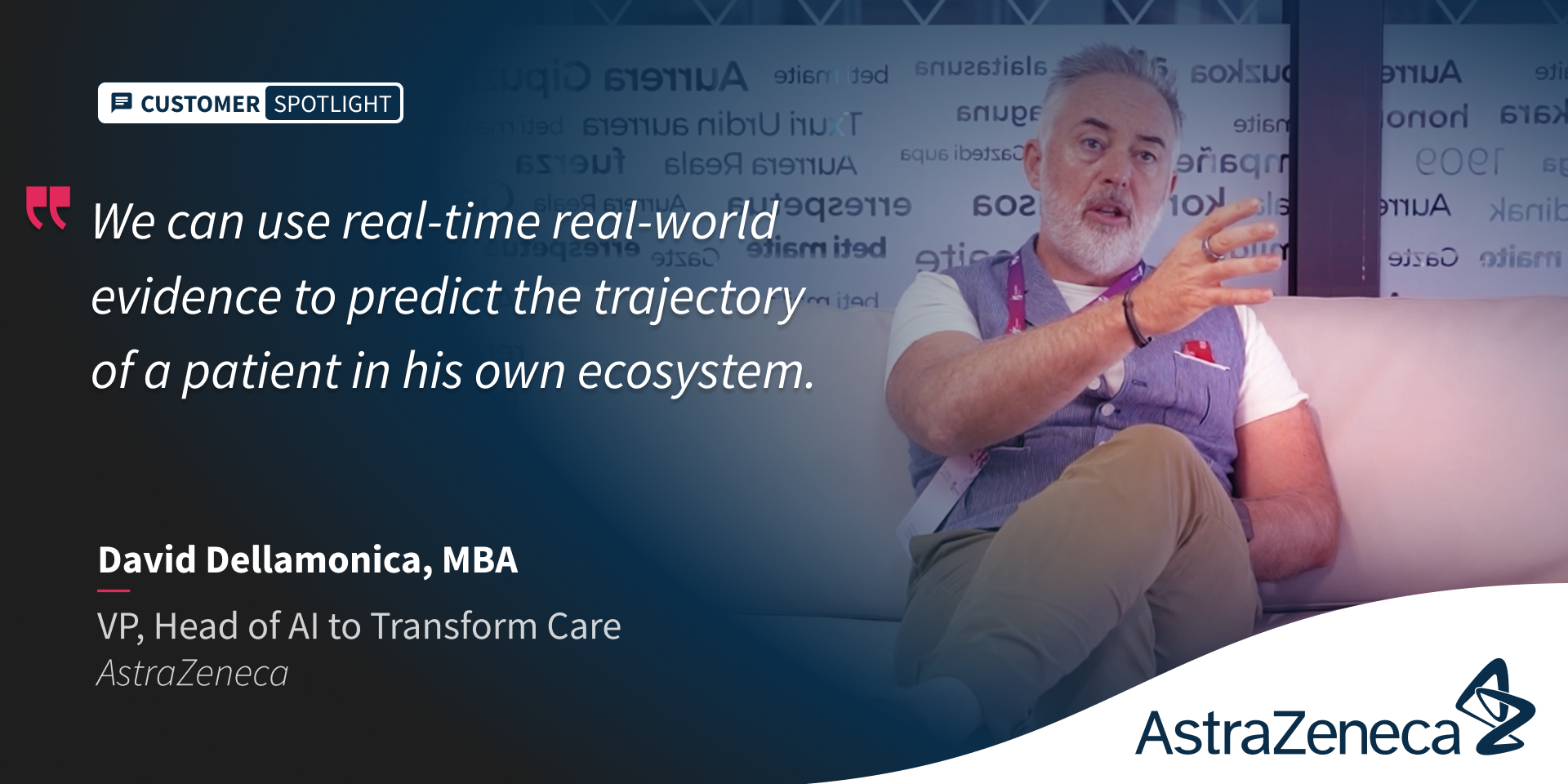
How are multimodal AI approaches reshaping precision oncology? In this interview, David Dellamonica, VP for AI to Transform Care at AstraZeneca, explains why multimodal AI has become a strategic imperative for pharma companies, how AstraZeneca is acting on it, and the three critical areas companies must focus on to support better cancer patient management.
I’m working for AstraZeneca. I’m David Dellamonica, and I’m the Vice President for AI to Transform Care.
You recently co-authored the AI Revolution: How Multimodal Intelligence Will Reshape the Oncology Ecosystem. Despite the clear potential, clinical adoption of multimodal AI approaches remains low. In your view, what is the single most important thing pharma companies need to do differently to reach a real inflection point?
It's a very good question. It's a very broad question, in fact. So, I think we published this paper in Nature in December 2025. And the purpose of this paper was to create, in fact, a visualization of how, in fact, we need to develop some multimodal models.
Let me explain a little bit. Multimodal models are using a variety of different types of modalities, meaning data modalities. And they are trying to reproduce how the brain of a physician will interact with this data.
So, in fact, it's more complex because you need to train different types of models and combine these models, in fact, to give you an answer. Now, the closer you are to the brain of the best physician, the closer you are to the reality of “I see a patient, I treat this patient”. So, to answer your question, pharma, in fact, we have many, many, many ways to tackle this type of question.
One of the questions is: what type of data we will use? And for this, you have two ways. One way is using our clinical trial data. The second way is using the real-world data. But we need to keep the data where they are. This is why I think we need to focus on real-time real-world evidence.
The second element that we need to do is the tech infrastructure. What tech can give us access to this data where they are?
And the third element is what type of intelligence we need to create. Intelligence is going in two directions. The direction that is regulated. Using these multimodal models for the purpose of finding patients, making sure they are not lost in the care pathway, or to optimize our R&D.
So, I will be deciding everything for everyone. I will focus on these three elements.
Better data, better tech infrastructure, and working on the intelligence area.
AdvantEDGE has attracted a lot of attention to this project. Can you tell us what it is and why AstraZeneca decided it was the right moment to develop and implement it as a strategy imperative?
So, in fact, it came from a piece of different parts of the puzzle. So, the puzzle came from a learning that we have that we can optimize our p-value in our clinical trial by re-analyzing this clinical trial. It came also from the fact that we can use real-time real-world evidence to predict the trajectory of a patient in his own ecosystem.
Now, when you combine different pieces of this type of project, in fact, you start to realize that, as I said previously, we need to work on different aspects.
The first aspect is the data. We need to work on the data aspect. We need to work better, but the data needs to stay where they are.
The second element is really we need to work on the tech environment, meaning what type of tech we need to use to develop these types of models. And the third element is what type of intelligence. In fact, the idea is to create a feedback loop that is going to the real-world in terms of intelligence and back to the R&D ecosystem.
What keeps us alive night and day is how we can solve biology. In fact, it's a complex discussion, but this feedback loop, in fact, could help us to solve.
So AdvantEDGE, in fact, is the recipe of all these different types of components.
You can consider, if you want an analogy.
AdvantEDGE is a factory. And in this factory, we use different types of platforms. At the end, we propose helping the physician to take better action for the benefit of the patients.
SOPHiA GENETICS products are for Research Use Only and not for use in diagnostic procedures unless specified otherwise.
SOPHiA DDM™ Dx Hereditary Cancer Solution, SOPHiA DDM™ Dx RNAtarget Oncology Solution and SOPHiA DDM™ Dx Homologous Recombination Deficiency Solution are available as CE-IVD products for In Vitro Diagnostic Use in the European Economic Area (EEA), the United Kingdom and Switzerland. SOPHiA DDM™ Dx Myeloid Solution and SOPHiA DDM™ Dx Solid Tumor Solution are available as CE-IVD products for In Vitro Diagnostic Use in the EEA, the United Kingdom, Switzerland, and Israel. Information about products that may or may not be available in different countries and if applicable, may or may not have received approval or market clearance by a governmental regulatory body for different indications for use. Please contact us to obtain the appropriate product information for your country of residence.
All third-party trademarks listed by SOPHiA GENETICS remain the property of their respective owners. Unless specifically identified as such, SOPHiA GENETICS’ use of third-party trademarks does not indicate any relationship, sponsorship, or endorsement between SOPHiA GENETICS and the owners of these trademarks. Any references by SOPHiA GENETICS to third-party trademarks is to identify the corresponding third-party goods and/or services and shall be considered nominative fair use under the trademark law.