Menu
Menu



Precision oncology is transforming cancer care by tailoring treatment decisions to the unique molecular profile of each patient’s disease. Central to this approach is biomarker testing – however, no single test can capture the full biological complexity of cancer. Tissue biopsy and liquid biopsy can be complementary tools that answer different but equally important clinical questions, achieving a complete and dynamic molecular picture.
In this blog, we will explore insights from the ROME trial, which highlight the potential value of integrating both biopsy modalities for solid tumor analysis1.
Why two biopsies may be better than one
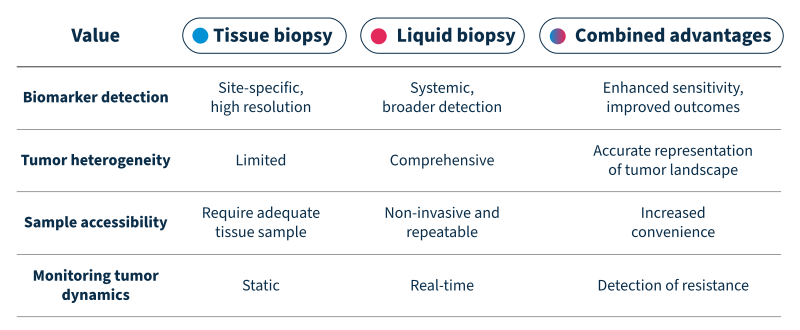
Tissue biopsy remains the cornerstone of cancer diagnostics, providing histology, tumor grading, and a deep view of local genomic alterations within a specific lesion. It is essential to confirm tumor type and assess immuno-oncology biomarkers such as microsatellite instability (MSI) and tumor mutational burden (TMB). However, tissue sampling is invasive, may not be repeatable, and captures only a snapshot from one tumor region at a single time point, potentially missing spatial and temporal heterogeneity2.
Liquid biopsy, by contrast, uses circulating tumor DNA to give a minimally invasive, real‑time snapshot of the genomic landscape across multiple tumor sites. It enables dynamic monitoring of treatment response and resistance mechanisms and can better reflect metastatic disease2, but may miss alterations in low-shedding tumors and does not provide histologic context3.
Together, the complementary strengths of both approaches may offer a combined strategy that provides a more complete molecular picture than either approach alone.
Inside the ROME trial design
The ROME trial was a phase II, multicenter, randomized study that enrolled 1,794 adults with advanced solid tumors in second or third line of therapy, regardless of histology. All patients underwent next‑generation sequencing on both tumor tissue and plasma with results reviewed by a centralized molecular tumor board (MTB). When actionable alterations were identified, 400 patients were randomized 1:1 to receive MTB‑guided tailored therapy (TT; targeted or immunotherapy) or standard-of-care (SoC) selected by the treating clinician, with crossover allowed at progression1.
The MTB integrated genomic data, clinical status, and actionability frameworks (including ESMO ESCAT) to recommend treatments, using defined variant allele frequency thresholds for tissue and liquid samples. This design allowed a unique assessment of how concordance or discordance between tissue and liquid biopsy results influences real‑world decisions and outcomes in a pan‑tumor setting1.
Concordance: how often tissue and liquid agree
In ROME, concordance was defined as the same actionable alteration being detected in both tissue and liquid biopsies and forming the basis for MTB‑recommended treatment. Under this definition, 49.2% of MTB‑indicated alterations were concordant (T+L group), while 34.8% were actionable only in tissue (T group) and 16.0% only in liquid (L group). Discordance arose from biological and technical factors, including molecular alteration discrepancies (particularly in PI3K/PTEN/AKT/mTOR and ERBB2 pathways), test failures (about 20% of discordant cases), and challenges in liquid-based biomarker detection such as TMB1.
What concordance means for patient outcomes
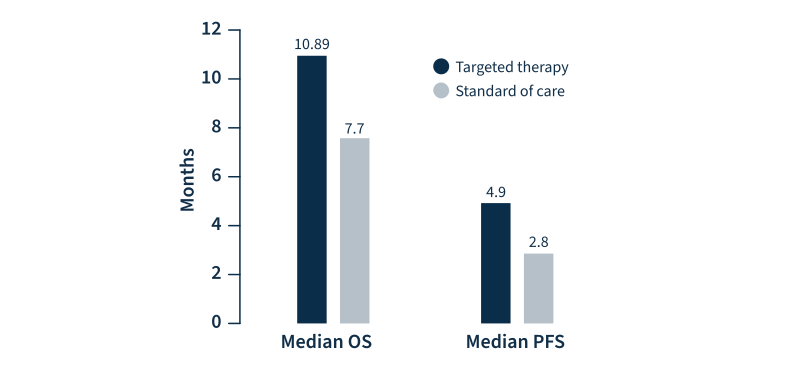
The most striking result from ROME is that patients with concordant actionable alterations in both tissue and liquid biopsies derived the greatest benefit from tailored therapies. In the concordant T+L group, patients receiving TT achieved1:
When focusing only on patients in the TT arm, survival followed a clear gradient1:
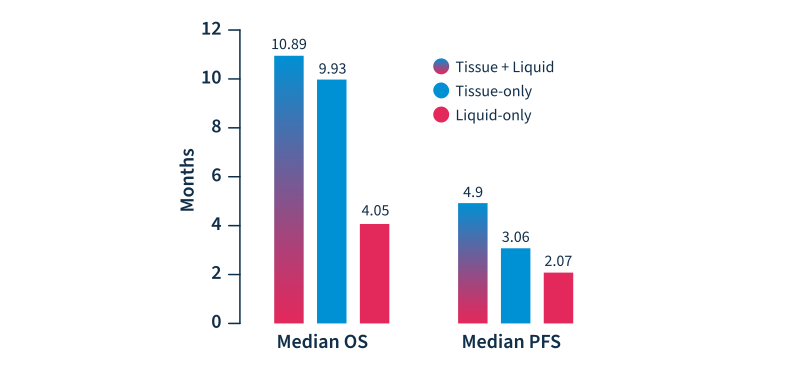
Patients with truly discordant molecular results had shorter overall and progression‑free survival than those with concordant profiles, supporting concordance as a potential predictive biomarker for the efficacy of matched therapy. Importantly, the survival advantage of concordant profiling was consistent across subgroups defined by tumor fraction and metastatic burden, indicating that its predictive value is robust to differences in shedding and disease extent1.
Implications for precision oncology
Findings from the ROME trial reinforce that tissue and liquid biopsies are not interchangeable but synergistic components of a modern precision oncology strategy.
Tissue biopsy remains indispensable for diagnosis, histopathology, and certain genomic events, while liquid biopsy broadens coverage across metastatic sites and over time, particularly when repeated sampling is needed. Integrating both modalities, supported by expert MTBs and comprehensive genomic profiling, maximizes the chance of detecting clinically actionable alterations and selecting patients who can truly benefit from targeted or immunotherapies1. Consistent with this, a study of 146 lung cancer patients undergoing matched tissue and plasma NGS using the same panel content reported patient‑level concordance of 83.6% and high sensitivity (≥85%) for several actionable drivers, including EGFR 19del, ALK and RET fusions, KRAS p.G12C and BRAF V600E, while also revealing subsets with tissue‑ or plasma‑specific variants4. These data underscore that liquid biopsy can function as a complementary tool to tissue biopsy, revealing both concordant variants and biopsy-specific variants when panel content is shared.
For clinical practice and trial design, ROME suggests several priorities: routinely pairing tissue and liquid profiling where feasible, explicitly considering concordance as a stratification or enrichment factor, and investing in advanced bioinformatic tools that reduce discordance and test failures1. As liquid biopsy platforms evolve and multimodal data integration matures, leveraging concordant insights from both biospecimens will be central to delivering on the promise of precision oncology for patients with advanced solid tumors.
This promise is increasingly recognized amongst healthcare experts. In a recent Delphi consensus endorsed by Italian scientific societies, most of the experts stated the importance of having both the data from tissue and liquid biopsy to integrate information from the two approaches (within a recommended ≤2-week sampling window), potentially yielding the maximum diagnostic accuracy and offering insights into the spatial-temporal heterogeneity of the disease5. However, the best testing approach – whether complementary or sequential – should be evaluated on a case-by-case basis with consideration of the patient's clinical history.
Capture the full molecular picture with SOPHiA DDM™
The SOPHiA DDM™ Platform provides seamless, end-to-end solutions for tissue and liquid biopsy, integrating powerful analytics with intuitive interpretation support to drive deeper insights and advance oncology research.
Healthcare institutions can benefit from:
With the SOPHiA DDM™ Platform, users gain access to the SOPHiA GENETICS Community, one of the largest global networks of connected healthcare institutions. Aggregated variant insights from anonymized data build collective intelligence across multiple disorders, further supporting confident, informed decision-making.
SOPHiA GENETICS products are for research use only, not for use in diagnostic procedures unless otherwise stated.
References
SOPHiA GENETICS products are for Research Use Only and not for use in diagnostic procedures unless specified otherwise.
SOPHiA DDM™ Dx Hereditary Cancer Solution, SOPHiA DDM™ Dx RNAtarget Oncology Solution and SOPHiA DDM™ Dx Homologous Recombination Deficiency Solution are available as CE-IVD products for In Vitro Diagnostic Use in the European Economic Area (EEA), the United Kingdom and Switzerland. SOPHiA DDM™ Dx Myeloid Solution and SOPHiA DDM™ Dx Solid Tumor Solution are available as CE-IVD products for In Vitro Diagnostic Use in the EEA, the United Kingdom, Switzerland, and Israel. Information about products that may or may not be available in different countries and if applicable, may or may not have received approval or market clearance by a governmental regulatory body for different indications for use. Please contact us to obtain the appropriate product information for your country of residence.
All third-party trademarks listed by SOPHiA GENETICS remain the property of their respective owners. Unless specifically identified as such, SOPHiA GENETICS’ use of third-party trademarks does not indicate any relationship, sponsorship, or endorsement between SOPHiA GENETICS and the owners of these trademarks. Any references by SOPHiA GENETICS to third-party trademarks is to identify the corresponding third-party goods and/or services and shall be considered nominative fair use under the trademark law.