
Menu
Menu
Variants of uncertain significance (VUS) remain a critical bottleneck in hereditary cancer testing, especially those in challenging regions like splice sites, non-coding areas, or affecting copy number. In this two-part session, discover how combining RNA-seq with DNA-based testing can functionally resolve these difficult cases.
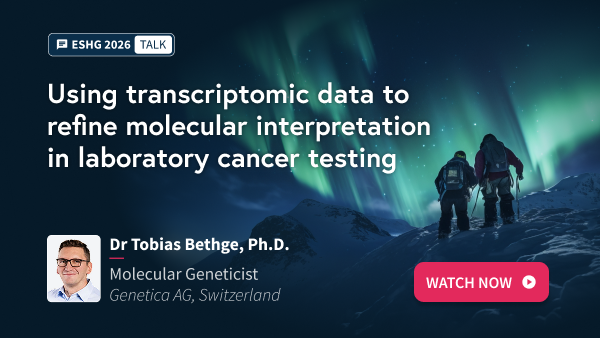
Tobias Bethge (Genetica AG) shares how his laboratory has integrated targeted RNA sequencing alongside DNA-based testing to functionally resolve VUS, highlighting practical considerations in sample selection, library preparation, and data interpretation. He then introduces a targeted capture-panel approach developed in collaboration with SOPHiA GENETICS, and walks through real case studies demonstrating the method's clinical impact.
Izabela Matyszczak (SOPHiA GENETICS) takes a deeper dive into this collaboration from the bioinformatics perspective, exploring project design, QC metrics, concordance data, and real-world case studies.
You'll come away with an understanding of how RNA-seq complements DNA sequencing, and how intelligent panel design and reliable bioinformatics can make this a practical approach.
You will learn:

Dr. rer.nat. Tobias Bethge
Genetica AG, Zurich, Switzerland

Izabela Matyszczak
Technical Product Manager, SOPHiA GENETICS
SOPHiA DDM™ applications and Alamut™ Visual Plus are For Research Use Only unless otherwise specified. The RNA-seq capture panel solution discussed is part of an ongoing research collaboration and is not yet commercially available. The opinions expressed are those of the speaker and may not represent the opinions of SOPHiA GENETICS.
SOPHiA GENETICS products are for Research Use Only and not for use in diagnostic procedures unless specified otherwise.
SOPHiA DDM™ Dx Hereditary Cancer Solution, SOPHiA DDM™ Dx RNAtarget Oncology Solution and SOPHiA DDM™ Dx Homologous Recombination Deficiency Solution are available as CE-IVD products for In Vitro Diagnostic Use in the European Economic Area (EEA), the United Kingdom and Switzerland. SOPHiA DDM™ Dx Myeloid Solution and SOPHiA DDM™ Dx Solid Tumor Solution are available as CE-IVD products for In Vitro Diagnostic Use in the EEA, the United Kingdom, Switzerland, and Israel. Information about products that may or may not be available in different countries and if applicable, may or may not have received approval or market clearance by a governmental regulatory body for different indications for use. Please contact us to obtain the appropriate product information for your country of residence.
All third-party trademarks listed by SOPHiA GENETICS remain the property of their respective owners. Unless specifically identified as such, SOPHiA GENETICS’ use of third-party trademarks does not indicate any relationship, sponsorship, or endorsement between SOPHiA GENETICS and the owners of these trademarks. Any references by SOPHiA GENETICS to third-party trademarks is to identify the corresponding third-party goods and/or services and shall be considered nominative fair use under the trademark law.
