
Menu
Menu
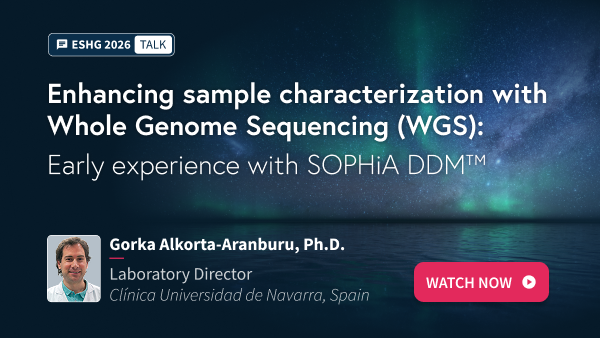
Speaker: Gorka Alkorta-Aranburu, PhD, CIMA LAB Diagnostics, Clínica Universidad de Navarra, Pamplona, Spain
About this webinar
Targeted gene panels remain efficient and affordable, but they carry known blind spots: deep intronic variants, complex structural rearrangements, and non-coding regulatory elements that fall outside their design. In this talk, Gorka Alkorta-Aranburu shares CIMA LAB Diagnostics' early experience moving from targeted panel testing toward whole genome sequencing (WGS), as part of an Early Access Program (EAP) with SOPHiA GENETICS, and the operational and analytical questions that came with it.
Gorka walks through the practical barriers labs face when considering WGS - data volume, compute demands, multi-variant-type detection, and the challenge of finding clinically relevant variants among millions of calls - and how a structured, four-phase EAP (platform familiarization, data quality assessment, singleton validation, and family trio analysis) helped his team evaluate whether SOPHiA DDM™ for WGS could meet the standards required for routine use.
The talk is grounded in real validation data and test cases from CIMA LAB's cohort. Raw data quality assessment across blood and saliva-derived samples revealed how DNA source materially affects coverage, including the impact of microbial DNA content in saliva samples on overall human coverage. Known variant call concordance testing showed high accuracy across SNVs, indels, and structural variants. Three singleton cases then illustrate where WGS closed gaps left by panel and exome testing: a compound heterozygous GJB2/GJB6 hearing loss case combining a point mutation with a regulatory deletion missed by exome sequencing; a pathogenic mitochondrial variant resolved with precision despite the risk of NUMT-related false positives; and a single-exon BRCA1 deletion resolved at nucleotide-level resolution where an exome panel could not separate signal from noise. Finally, Gorka presents early results from applying SOPHiA DDM™ familial variant analysis to 11 previously untested WGS trios, with high parental concordance rates supporting its use in variant prioritization.
You will learn:
SOPHiA DDM™ applications are For Research Use Only unless otherwise specified. The opinions expressed are those of the speaker and may not represent the opinions of SOPHiA GENETICS.
SOPHiA GENETICS products are for Research Use Only and not for use in diagnostic procedures unless specified otherwise.
SOPHiA DDM™ Dx Hereditary Cancer Solution, SOPHiA DDM™ Dx RNAtarget Oncology Solution and SOPHiA DDM™ Dx Homologous Recombination Deficiency Solution are available as CE-IVD products for In Vitro Diagnostic Use in the European Economic Area (EEA), the United Kingdom and Switzerland. SOPHiA DDM™ Dx Myeloid Solution and SOPHiA DDM™ Dx Solid Tumor Solution are available as CE-IVD products for In Vitro Diagnostic Use in the EEA, the United Kingdom, Switzerland, and Israel. Information about products that may or may not be available in different countries and if applicable, may or may not have received approval or market clearance by a governmental regulatory body for different indications for use. Please contact us to obtain the appropriate product information for your country of residence.
All third-party trademarks listed by SOPHiA GENETICS remain the property of their respective owners. Unless specifically identified as such, SOPHiA GENETICS’ use of third-party trademarks does not indicate any relationship, sponsorship, or endorsement between SOPHiA GENETICS and the owners of these trademarks. Any references by SOPHiA GENETICS to third-party trademarks is to identify the corresponding third-party goods and/or services and shall be considered nominative fair use under the trademark law.
