
Menu
Menu


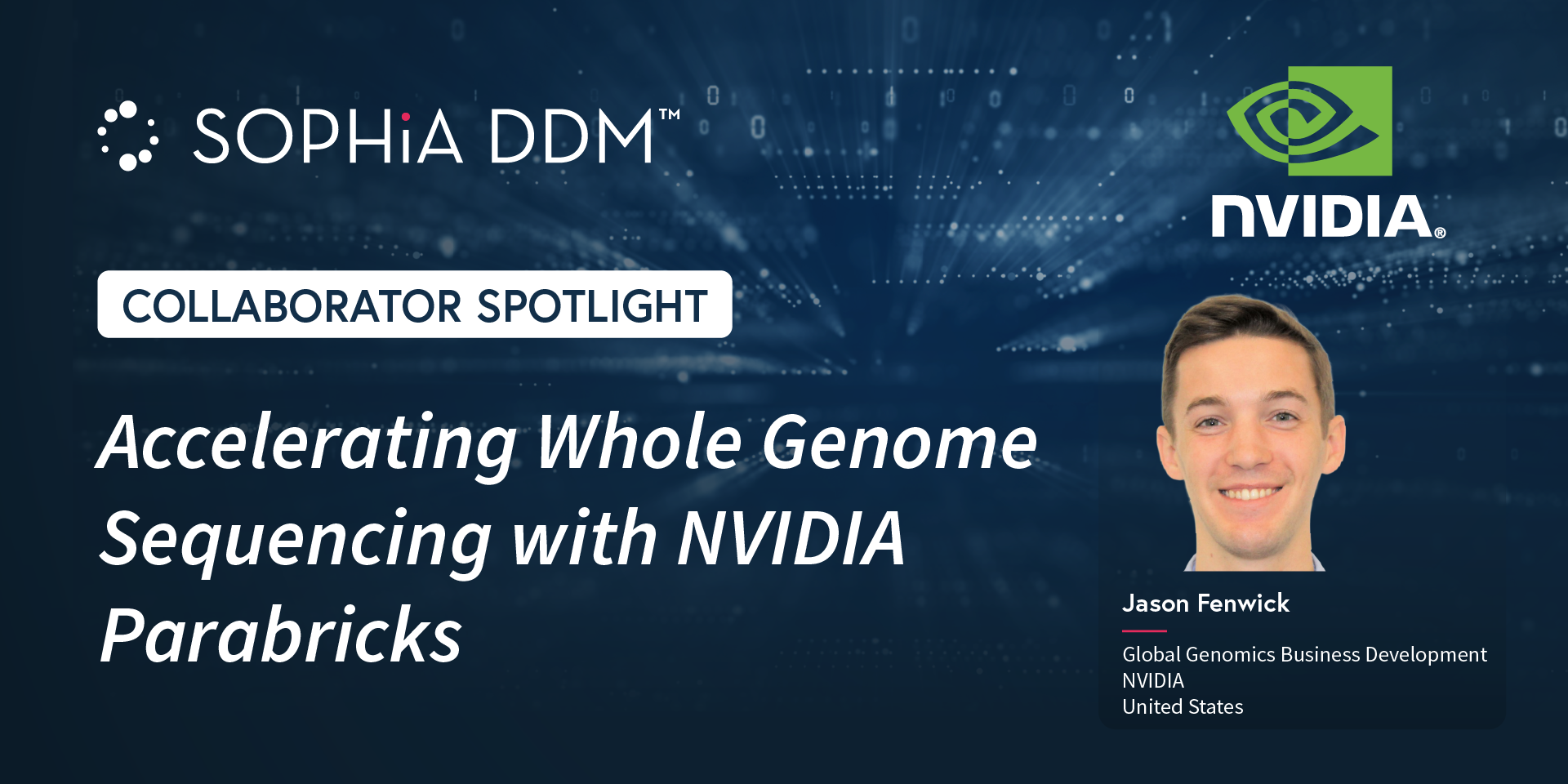
Question 1
To start, for those of us who are unfamiliar with GPUs, could you explain how GPU acceleration improves the speed of genomic analysis compared to traditional CPU-based methods?
Jason, NVIDIA
Graphics processing units (GPUs) are exceptional at accelerating processes that are highly parallelizable, meaning processes that require many computations which do not depend on previous calculations or steps. Unlike central processing units (CPUs), which typically only have a maximum of a few dozen cores, NVIDIA GPUs have thousands of cores. Many algorithms in genomics, including alignment and variant calling, are better suited to parallel computing. For example, determining the alignment of one read does not depend on first determining the alignment of the previous read.
Question 2
How does NVIDIA accelerate specific steps in genomic data processing pipelines, such as alignment and variant calling?
Jason, NVIDIA
NVIDIA Parabricks is a scalable genomics software suite for secondary analysis that provides GPU-accelerated versions of trusted, open-source tools. By accelerating these gold-standard bioinformatics tools that can take hours to run on CPU, Parabricks provides speedups of up to 100x while maintaining accuracy of the open-source versions.
Question 3
How does NVIDIA Parabricks handle the complexity of genomic data to ensure accuracy and reliability while still achieving high speeds?
Jason, NVIDIA
Speed is not always the primary concern. Accuracy and reliability is paramount in bioinformatic pipelines. That’s why GPU-accelerated tools within Parabricks provide equivalent results to the gold-standard community versions. Parabricks also includes tools such as Giraffe, a pangenome aligner from the University of California, Santa Cruz (UCSC), which has been shown to be more accurate when paired with Google’s DeepVariant than other leading alignment tools.
Question 4
Could you share any real-world examples where Parabricks accelerated time to insights, particularly in clinical or research applications?
Jason, NVIDIA
Parabricks has helped multiple organizations dramatically reduce analysis time - including the Francis Crick Institute saving nine years of processing time in their TRACERx EVO study, which aims to understand tumor evolution in non-small cell lung cancer with whole genome sequencing. More recently, NYU Langone Health achieved a 10x improvement in variant calling runtimes for their deciphEHR project, enabling them to scale towards their goal of sequencing 100,000 genomes and advancing genomic medicine for research and clinical utility.
Parabricks saved the Francis Crick Institute 9 years of processing time
Question 5
Could you share some technical details on how NVIDIA Parabricks and DeepVariant efficiently manage large-scale sequencing data, such as through compression or processing algorithms?
Jason, NVIDIA
DeepVariant is a deep-learning based variant caller, which actually applies concepts from computer vision to genomics. It utilizes convolutional neural networks (CNNs) to determine true variants and sequencing errors from pileup images. Deploying DeepVariant on GPUs allows for efficient inference of this model and provides high throughput analysis at scale.
Question 6
What were some of the technical challenges NVIDIA faced when optimizing Parabricks for genomic data, and how were they overcome?
Jason, NVIDIA
One of the most difficult challenges is understanding the code base of these community tools. Since Parabricks replicates the results of open-source tools in its GPU-accelerated versions, a deep understanding of the original code is required. Thankfully, we collaborate with the teams that develop these community tools, such as the Broad Institute, Google, and UCSC. These collaborations allow for us to interact directly with the developer teams and validate our work.
Question 7
Can you tell us about the collaboration between NVIDIA and SOPHiA GENETICS in developing SOPHiA DDM™ for Whole Genome Sequencing, and how NVIDIA’s technologies were integrated into the workflow?
Jason, NVIDIA
SOPHiA GENETICS has integrated Parabricks alignment and variant calling tools into its SOPHiA DDM™ whole genome sequencing application. This integration delivered a tenfold acceleration in alignment, significantly speeding up whole-genome data analysis while reducing turnaround times and associated computational costs.
Parabricks integration delivered 10x faster alignment,
reducing SOPHiA DDM™ WGS turnaround times
Question 8
What have been the key successes and learnings from this collaboration that have contributed to creating a faster and more scalable genomic solution?
Jason, NVIDIA
It has been a great experience working with the SOPHiA GENETICS team and playing a part in their mission to democratize access to data-driven medicine. Providing an accelerated whole genome sequencing solution brings comprehensive genetic analysis to the clinic and enables identification of rare diseases that other methods can miss.
Question 9
Finally, how do you see the role of GPUs and AI evolving in the field of clinical genomics over the next few years?
Jason, NVIDIA
As the cost of sequencing continues to come down, data analysis and bioinformatics will continue to become more of a bottleneck in terms of both time and cost. These bottlenecks can be removed by accelerating analysis on GPUs and leveraging the latest methods in AI. This will enable faster time from analysis to insight, democratizing whole genome sequencing in clinical genomics.
Another evolving area is multimodal AI models that integrate genomic data with electronic health records and imaging to make patient-specific predictions. These models' ability to better predict treatment outcomes and match patients to the most effective treatments, has real promise for delivering more effective and precise care.
As whole genome sequencing is increasingly adopted in clinical genomics, computational performance and scalability have become key constraints, particularly for alignment and variant calling in high-throughput settings. GPU-accelerated solutions such as NVIDIA Parabricks help address these challenges by significantly reducing secondary analysis time while preserving the accuracy required for clinical-grade interpretation.
To learn more about how SOPHiA GENETICS supports efficient and scalable clinical WGS analysis, explore SOPHiA DDM™ for Whole Genome Sequencing.
SOPHiA GENETICS products are for Research Use Only and not for use in diagnostic procedures unless specified otherwise.
SOPHiA DDM™ Dx Hereditary Cancer Solution, SOPHiA DDM™ Dx RNAtarget Oncology Solution and SOPHiA DDM™ Dx Homologous Recombination Deficiency Solution are available as CE-IVD products for In Vitro Diagnostic Use in the European Economic Area (EEA), the United Kingdom and Switzerland. SOPHiA DDM™ Dx Myeloid Solution and SOPHiA DDM™ Dx Solid Tumor Solution are available as CE-IVD products for In Vitro Diagnostic Use in the EEA, the United Kingdom, Switzerland, and Israel. Information about products that may or may not be available in different countries and if applicable, may or may not have received approval or market clearance by a governmental regulatory body for different indications for use. Please contact us to obtain the appropriate product information for your country of residence.
All third-party trademarks listed by SOPHiA GENETICS remain the property of their respective owners. Unless specifically identified as such, SOPHiA GENETICS’ use of third-party trademarks does not indicate any relationship, sponsorship, or endorsement between SOPHiA GENETICS and the owners of these trademarks. Any references by SOPHiA GENETICS to third-party trademarks is to identify the corresponding third-party goods and/or services and shall be considered nominative fair use under the trademark law.