Menu
Menu


Can you introduce the National Reference Laboratory (NRL) and its role in advancing molecular diagnostics and precision medicine in the Middle East?
National Reference Laboratory (NRL), part of M42, is a high-complexity reference laboratory serving healthcare providers across the UAE and the wider region. Our Molecular Diagnostics and Genomics Department supports clinicians with advanced testing across oncology, inherited disease, infectious disease, transplant-related molecular testing, and genomic medicine. Our mandate is not only to generate technically accurate results, but to translate complex molecular findings into clinically meaningful information that can guide patient management.
In precision medicine, regional capability matters. Patients and clinicians benefit when advanced molecular diagnostics are available locally, with appropriate clinical governance, quality systems, rapid turnaround time, and close interaction between laboratory experts, pathologists, oncologists, hematologists, geneticists, and multidisciplinary tumor boards. NRL’s role is to help build that infrastructure: delivering reliable genomic testing, strengthening interpretation frameworks, supporting local clinical pathways, and contributing to the development of precision medicine programs in the Middle East.
"What stood out from our collaboration with SOPHiA GENETICS was the combination of analytical depth, scalability, and a clear focus on democratizing access to high-quality genomic analysis."
How has demand for comprehensive genomic profiling evolved across the Middle East in recent years?
Demand has grown substantially, both in volume and in clinical sophistication. A few years ago, many requests were still focused on single-gene or limited hotspot testing. Today, clinicians increasingly expect broader genomic profiling that can identify actionable mutations, resistance mechanisms, copy-number changes, genomic signatures, fusions, and biomarkers relevant to clinical trial eligibility.
This change is driven by the rapid expansion of targeted therapies, immunotherapy, antibody-drug conjugates, PARP inhibitors, and molecularly guided treatment pathways. In oncology in particular, comprehensive genomic profiling is increasingly moving from a late-line option to an earlier component of the diagnostic and treatment-planning pathway. The Middle East is also seeing greater recognition that local genomic data generation is important for equity, faster access, and building regional evidence rather than relying entirely on external testing ecosystems.
What challenges do clinicians face when selecting targeted therapies without access to advanced genomic insights? How important is it for regional laboratories to adopt scalable data-driven platforms when building national precision medicine programs?
Without advanced genomic insights, clinicians may be forced to make treatment decisions with an incomplete understanding of the tumor biology. This can lead to missed therapeutic opportunities, delayed identification of resistance mechanisms, uncertainty around clinical trial eligibility, and greater reliance on sequential testing that consumes tissue, increases turnaround time, and may ultimately provide fragmented information.
Scalable, data-driven platforms are essential for national precision medicine programs because the challenge is no longer simply sequencing. The real challenge is not only generating genomic data, but ensuring consistent analysis, interpretation, prioritization, and reporting, with genomic findings integrated into the broader clinical and pathological context. At NRL, this is strengthened by close collaboration with Anatomical Pathology teams and treating clinicians, enabling integrated reporting that supports more informed and clinically actionable decision-making. A regional laboratory must be able to manage increasing complexity while maintaining quality, reproducibility, auditability, and turnaround time. For national programs, this requires standardized workflows, strong bioinformatics, traceable analytics, secure data handling, and the ability to scale across multiple applications without rebuilding infrastructure for every new assay.
"SOPHiA GENETICS approached genomic medicine research as more than a software solution; The platform was designed around the practical needs of laboratories that must transform complex NGS data into reliable, interpretable outputs."
What initially stood out about SOPHiA GENETICS’ approach to data-driven medicine and genomic analysis?
What stood out was the combination of analytical depth, scalability, and a clear focus on democratizing access to high-quality genomic analysis. SOPHiA GENETICS approached genomic medicine research as more than a software solution; the platform was designed around the practical needs of laboratories that must transform complex NGS data into reliable, interpretable outputs.
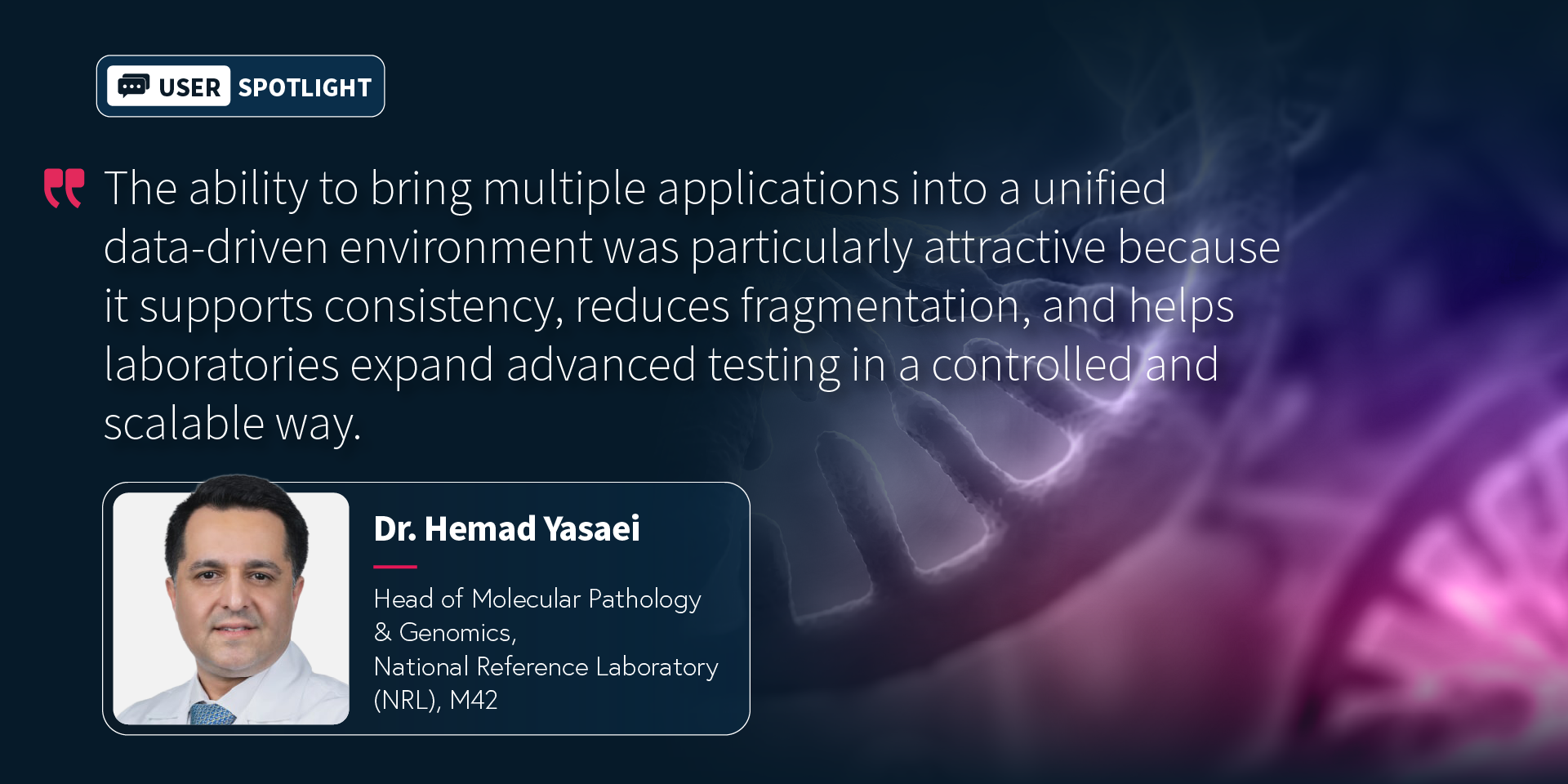
For a clinical laboratory, this is important. We need systems that can support routine analytically-sound operations, accommodate different disease areas, and provide confidence in the detection and interpretation of complex genomic alterations. The ability to bring multiple applications into a unified data-driven environment was particularly attractive because it supports consistency, reduces fragmentation, and helps laboratories expand advanced testing in a controlled and scalable way.
NRL uses several applications powered by SOPHiA DDM™, including solid tumor analysis, HRD, MRD, and liquid biopsy workflows. What motivated you to adopt this multi-application approach and how does having multiple oncology applications on a single platform help streamline genomic analysis in your lab?
Our decision was driven by the clinical reality of oncology. Cancer care does not fit neatly into one assay or one specimen type. A patient pathway may require solid tumor profiling, homologous recombination deficiency assessment, measurable residual disease monitoring, and, increasingly, liquid biopsy approaches for advanced disease or longitudinal follow-up. Building these capabilities as isolated workflows creates inefficiency and inconsistency.
Having multiple oncology research applications on a single platform helps us standardize how data are analyzed, reviewed, and reported. It supports common operating principles, a more consistent user experience for scientists and bioinformaticians, and easier cross-training across applications. It also helps the laboratory scale responsibly: as testing volumes increase, we can add new research use cases without creating disconnected analytical silos. This is particularly important for a regional reference laboratory aiming to provide comprehensive precision oncology research services while maintaining quality, turnaround time, and interpretive consistency.
As testing volumes increase, maintaining efficiency and consistency becomes critical. How has your workflow evolved to support growing demand for genomic testing?
Our workflow has evolved from a test-by-test model toward a more integrated, platform-based operating model. We have focused on standardizing pre-analytical requirements, research sample triage, library preparation, sequencing, bioinformatics review, variant interpretation, and final reporting. We also increasingly manage capacity through both a volume lens and a complexity lens, because a high-complexity genomic case may require substantially more interpretive effort than a routine molecular assay.
Operationally, we have invested in automation, staff cross-training, structured review pathways, and closer integration between molecular scientists, bioinformaticians, pathologists, and clinicians. Analytically, our goal is to reduce unnecessary manual variation while preserving expert oversight. The laboratory must be efficient, but efficiency cannot come at the expense of clinical quality. The right workflow is one that enables scale, preserves scientific rigor, and delivers information in a timeframe that remains clinically useful.
"The ability to bring multiple applications into a unified data-driven environment was particularly attractive because it supports consistency, reduces fragmentation, and helps laboratories expand advanced testing in a controlled and scalable way."
What operational or analytical challenges were addressed through your collaboration with SOPHiA GENETICS?
The collaboration helped address several practical challenges that laboratories face when expanding advanced genomic testing. These include managing complex NGS data, standardizing analysis across different oncology applications, supporting reproducible variant detection and prioritization, and reducing the burden of maintaining multiple disconnected analytical pipelines.
From an operational perspective, the platform-based approach supports a more streamlined review process and provides a foundation for expanding test menus without reinventing the analytical workflow each time. From an analytical perspective, it helps manage complexity across different alteration types and specimen contexts, while still allowing expert laboratory review. For us, the value is not only in generating data, but in building a sustainable model for delivering high-complexity genomic insights at scale.
Looking ahead, what excites you most about the future of precision oncology in the Middle East?
What excites me most is the opportunity to move precision oncology from selective access to routine, locally delivered care. The Middle East has the clinical expertise, healthcare ambition, and infrastructure to become a strong precision medicine hub. The next step is to ensure that advanced molecular profiling, molecular tumor board integration, clinical trial matching, longitudinal monitoring, and local outcomes data become part of a mature precision oncology ecosystem.
At NRL (M42), this progress is being built through strong institutional collaboration, robust quality control, and clear governance. We work closely with Anatomical Pathology teams, treating clinicians, and clinical scientists to ensure that genomic results are interpreted within the full clinical and pathological context. Our close interaction with scientists from Memorial Sloan Kettering Cancer Center (USA) has further strengthened our approach to comprehensive genomic profiling, assay implementation, interpretation, and integrated reporting. In parallel, quality assurance through external programs such as European Molecular Genetics Quality Network (EMQN) supports analytical confidence, benchmarking, and continuous improvement.
I am particularly excited about the convergence of comprehensive genomic profiling, liquid biopsy, MRD, transcriptomics, digital pathology, and AI-supported interpretation. These technologies will increasingly help us understand cancer as a dynamic disease rather than a static diagnosis. If implemented correctly, the region can generate its own evidence, improve access for patients, reduce dependency on send-out testing, and contribute meaningfully to global precision oncology knowledge.
In what ways does SOPHiA GENETICS act as a strategic partner supporting your laboratory’s long-term vision for precision medicine?
A strategic partner in precision medicine research must support more than implementation of a single assay. SOPHiA GENETICS supports a broader vision by providing a scalable platform that can grow with the laboratory, accommodate multiple applications, and help standardize analytical workflows across oncology research cases. This aligns well with our objective to build local, high-quality, clinically relevant genomic services rather than relying on fragmented or externally dependent models.
The partnership is also important because precision medicine is continuously evolving. New biomarkers, new therapeutic classes, new evidence frameworks, and new specimen types are constantly emerging. We need partners who can support innovation, scientific dialogue, workflow optimization, and responsible expansion. In that sense, SOPHiA GENETICS contributes to our long-term goal of making advanced genomic medicine more accessible, sustainable, and clinically impactful for patients in the UAE and the region.
For laboratories looking to build advanced oncology testing programs, what lessons or advice would you share from NRL (M42)’s experience?
My first advice is to build the program around clinical need, not technology alone. The most successful oncology testing programs are those that are closely aligned with oncologists, hematologists, pathologists, surgeons, genetic counselors, and molecular tumor boards. The laboratory must understand where genomic testing changes management, where turnaround time matters most, and how results will be used in real clinical pathways.
Second, invest early in quality, governance, bioinformatics, and interpretation. Sequencing is only one part of the process. The laboratory must have clear validation frameworks, quality metrics, variant review processes, reporting standards, data security controls, and mechanisms for continuous learning.
Third, choose scalable platforms and partners. As oncology evolves, laboratories will need to add new applications, new biomarkers, and new specimen types. A fragmented model may work initially but becomes difficult to sustain. A platform-based, data-driven approach helps laboratories grow with consistency and confidence. Finally, remain ambitious. Regional laboratories should not only import precision medicine; they should help shape it by generating local evidence, building multidisciplinary expertise, and delivering advanced genomic insights closer to the patient.
We would like to warmly thank Dr. Hemad Yasaei for his engagement in this user spotlight as well at the entire NRL team for their trust and continuous collaboration in advancing precision medicine in the Middle East and beyond.
SOPHiA GENETICS products are for Research Use Only and not for use in diagnostic procedures unless specified otherwise.
SOPHiA DDM™ Dx Hereditary Cancer Solution, SOPHiA DDM™ Dx RNAtarget Oncology Solution and SOPHiA DDM™ Dx Homologous Recombination Deficiency Solution are available as CE-IVD products for In Vitro Diagnostic Use in the European Economic Area (EEA), the United Kingdom and Switzerland. SOPHiA DDM™ Dx Myeloid Solution and SOPHiA DDM™ Dx Solid Tumor Solution are available as CE-IVD products for In Vitro Diagnostic Use in the EEA, the United Kingdom, Switzerland, and Israel. Information about products that may or may not be available in different countries and if applicable, may or may not have received approval or market clearance by a governmental regulatory body for different indications for use. Please contact us to obtain the appropriate product information for your country of residence.
All third-party trademarks listed by SOPHiA GENETICS remain the property of their respective owners. Unless specifically identified as such, SOPHiA GENETICS’ use of third-party trademarks does not indicate any relationship, sponsorship, or endorsement between SOPHiA GENETICS and the owners of these trademarks. Any references by SOPHiA GENETICS to third-party trademarks is to identify the corresponding third-party goods and/or services and shall be considered nominative fair use under the trademark law.