Menu
Menu


Genetic factors are believed to contribute to ~10% of chronic kidney disease (CKD) cases. Despite this, determining the most effective and cost-efficient approach to genomic analysis in nephrology remains an active area of scientific discussion.
Should clinicians rely on targeted gene panels, broad exome-wide sequencing, or something in between? A newly published multicenter study in Clinical Genetics offers evidence to help answer that question, and the findings may surprise you.
Researchers collaborated on a retrospective research study evaluating the utility of a focused, 44-gene nephropathy panel in 692 individuals from five European centers across Italy and Spain with suspected hereditary kidney conditions.
The application at the heart of the study is the SOPHiA DDM™ Nephropathies Solution (NES), a 44-gene test developed by SOPHiA GENETICS for use in research settings. This end-to-end genomic solution combines a capture-based target enrichment kit with sophisticated secondary and tertiary analysis in the SOPHiA DDM™ Platform. It is this shared analytical platform (SOPHiA DDM™) that made the cross-institutional collaboration not only possible, but scientifically rigorous.
"SOPHiA GENETICS played a key role as a facilitator of collaboration among the different participating institutions, providing a shared technological infrastructure that enabled the integration, analysis, and standardized comparison of genomic data." - Carmen Ayuso, Ana Bustamante & Almudena Ávila, University Hospital Fundación Jiménez Díaz & Quirónsalud Public Hospitals
By using the same panel and analysis environment across all the participating centers, the teams were able to generate comparable, standardized outputs, offering a meaningful advantage in multicenter research where methodological heterogeneity often complicates cross-site comparisons.
The results of the study are notable for what they demonstrate about the success of a targeted genomic approach for the evaluation of kidney disease:
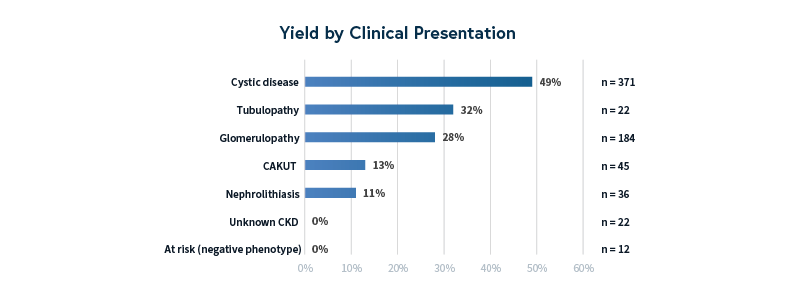
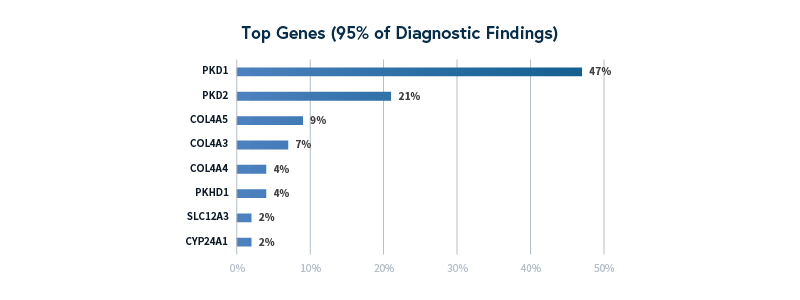
The research also identified four potential independent clinical predictors associated with a higher likelihood of a positive finding: clinical presentation of cystic disease over nephrolithiasis, family history, early age of disease onset, and kidney failure. A free online calculator based on these predictors is now publicly available to support research teams.
"The main message I will take forward is that a focused 44-gene panel can provide meaningful value when used in well-phenotyped subjects. In our study, the panel achieved a 36% yield, with the highest yield in cystic disease. The genetic result frequently confirmed, established, or revised the previous conclusions." - Prof. Riccardo Magistroni, University of Modena and Reggio Emilia, University Hospital of Modena.
The impact assessment focused on 86 subjects at the coordinating center (the University Hospital of Modena) and found that genomic results supported the previous clinical conclusion in 70% of cases.
One of the most compelling contributions of this research is less about the numbers themselves and more about how they were generated. Kidney disease genetics is a specialized field, and individual centers may only encounter a subset of the genetic landscape. Pooling data across institutions with different healthcare systems, patient populations, and clinical contexts produces evidence that is far more generalizable.
"Collaboration is essential for the advancement of science, especially in highly specialized fields such as nephrogenetics. It allows the integration of multidisciplinary knowledge, the validation of methodologies in larger cohorts, and the generation of robust evidence. In clinical practice, this cooperation facilitates the implementation of new technologies, promotes their standardization, and accelerates their incorporation into routine use, contributing to more precise and efficient medicine." - Carmen Ayuso, Ana Bustamante & Almudena Ávila, University Hospital Fundación Jiménez Díaz & Quirónsalud Public Hospitals
"Collaboration is absolutely central to advancing science and ensuring that new technologies are successfully adopted in clinical practice. Thanks to SOPHiA GENETICS, we had the opportunity to compare experiences across European countries with different healthcare systems." - Alessandra Terracciano, IRCCS Ospedale Pediatrico Bambino Gesù, Rome
The SOPHiA GENETICS Community played a meaningful role here. The collaboration originated from a desire among the kidney panel users across Europe to harmonize their approaches, compare findings, and build a shared evidence base - precisely the kind of network-driven science that underpins the SOPHiA DDM™ Platform's design.
The SOPHiA DDM™ Nephropathies Solution used in this study is intended for research use only and is not approved for diagnostic procedures. However, research conducted with this panel contributes to the growing body of evidence that helps the scientific community understand the genomic landscape of hereditary kidney conditions.
The platform's ability to support standardized NGS data processing across multiple sites to enable the kind of consistent, comparable analysis required for multicenter research, is central to why this study was feasible at a scale of nearly 700 cases across five European centers.
"SOPHiA GENETICS provided a shared technical framework for this multicenter study through the same nephropathy panel and analysis environment. This helped participating institutions work with comparable data and a common workflow, making collaboration across centers more practical and consistent." - Prof. Riccardo Magistroni, University of Modena and Reggio Emilia, University Hospital of Modena.
"The experience with SOPHiA GENETICS was the starting point for this productive collaboration." - Alessandra Terracciano, IRCCS Ospedale Pediatrico Bambino Gesù
The authors are careful to acknowledge the study’s retrospective nature and the limitations of a 44-gene panel relative to broader sequencing approaches. Exome and genome sequencing can uncover variants in genes outside a targeted panel's scope, and larger prospective studies will be needed to validate the predictive model and confirm the findings at scale.
That said, the study makes a compelling research-based case for the role of targeted, epidemiologically-grounded panels in nephrology, particularly in resource-constrained settings where cost-effectiveness and turnaround time matter.
The research also underscores the value of patient stratification. Clinical predictors such as family history, time of disease onset, phenotype, and kidney function can be used to guide decisions about who is most likely to benefit from genomic analysis.
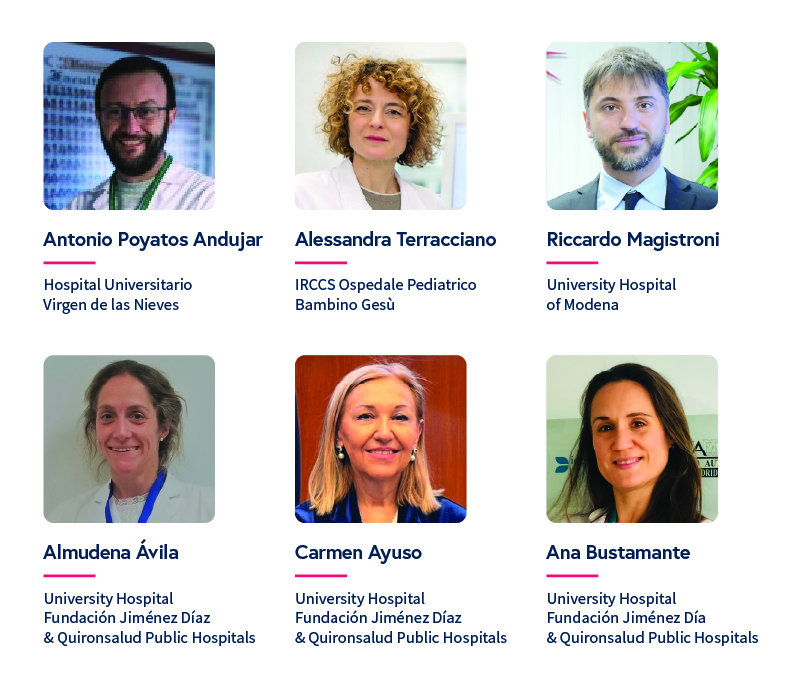
This publication reflects the expertise and commitment of researchers across six European institutions:
University of Modena and Reggio Emilia / University Hospital of Modena, Italy
Silvia Giovanella, Maria Ferri, Giulia Ligabue, Marco Ferrarini, Johanna Chester, Francesca Testa, Giulia Ligabue, Marco Ferrarini, Gaetano Alfano, Elena Tenedini, Lucia Artuso, Marco Marino, Olga Calabrese, Enrico Tagliafico, Riccardo Magistroni
Hospital Universitario Virgen de las Nieves, Granada, Spain
Antonio Miguel Poyatos-Andújar, Maria Mar Aguila Garcia
University Hospital Fundación Jiménez Díaz &Quirónsalud Public Hospitals, Madrid, Spain
Almudena Avila-Fernandez, Ana Bustamante-Aragonés, Carmen Ayuso
University Hospital of Parma / UO Genetica Medica-University Hospital Parma, Italy
Antonio Percesepe, Davide Martorana
Ospedale Pediatrico Bambino Gesù, IRCCS, Rome, Italy
Alessandra Terracciano, Laura Massella
IRCCS University Hospital of Bologna, Italy
Dino Gibertoni
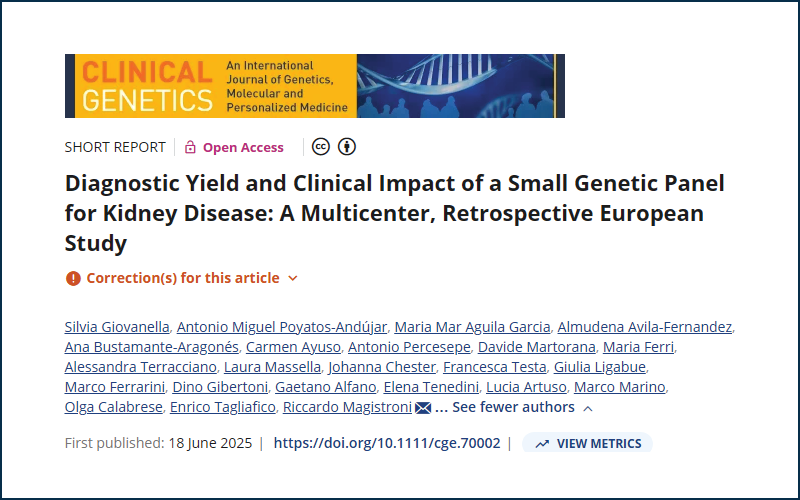
The paper is published open access in Clinical Genetics (2026; 109:136–140) and is freely available to read in full.
The SOPHiA DDM™ Nephropathies Solution (NES) is a 44-gene targeted panel designed to support genomic analysis in hereditary kidney conditions. Powered by the SOPHiA DDM™ Platform, it leverages AI-driven algorithms to call, annotate, and prioritize variants for further analysis, while connecting researchers with shared scientific interests through the SOPHiA GENETICS Community.
For research use only. Not for use in diagnostic procedures.
SOPHiA GENETICS is committed to supporting the global research community with the tools and infrastructure needed to advance genomic science. The publication highlighted in this article was authored independently by its named researchers. SOPHiA GENETICS did not author or fund this study.
SOPHiA GENETICS products are for Research Use Only and not for use in diagnostic procedures unless specified otherwise.
SOPHiA DDM™ Dx Hereditary Cancer Solution, SOPHiA DDM™ Dx RNAtarget Oncology Solution and SOPHiA DDM™ Dx Homologous Recombination Deficiency Solution are available as CE-IVD products for In Vitro Diagnostic Use in the European Economic Area (EEA), the United Kingdom and Switzerland. SOPHiA DDM™ Dx Myeloid Solution and SOPHiA DDM™ Dx Solid Tumor Solution are available as CE-IVD products for In Vitro Diagnostic Use in the EEA, the United Kingdom, Switzerland, and Israel. Information about products that may or may not be available in different countries and if applicable, may or may not have received approval or market clearance by a governmental regulatory body for different indications for use. Please contact us to obtain the appropriate product information for your country of residence.
All third-party trademarks listed by SOPHiA GENETICS remain the property of their respective owners. Unless specifically identified as such, SOPHiA GENETICS’ use of third-party trademarks does not indicate any relationship, sponsorship, or endorsement between SOPHiA GENETICS and the owners of these trademarks. Any references by SOPHiA GENETICS to third-party trademarks is to identify the corresponding third-party goods and/or services and shall be considered nominative fair use under the trademark law.