Menu
Menu


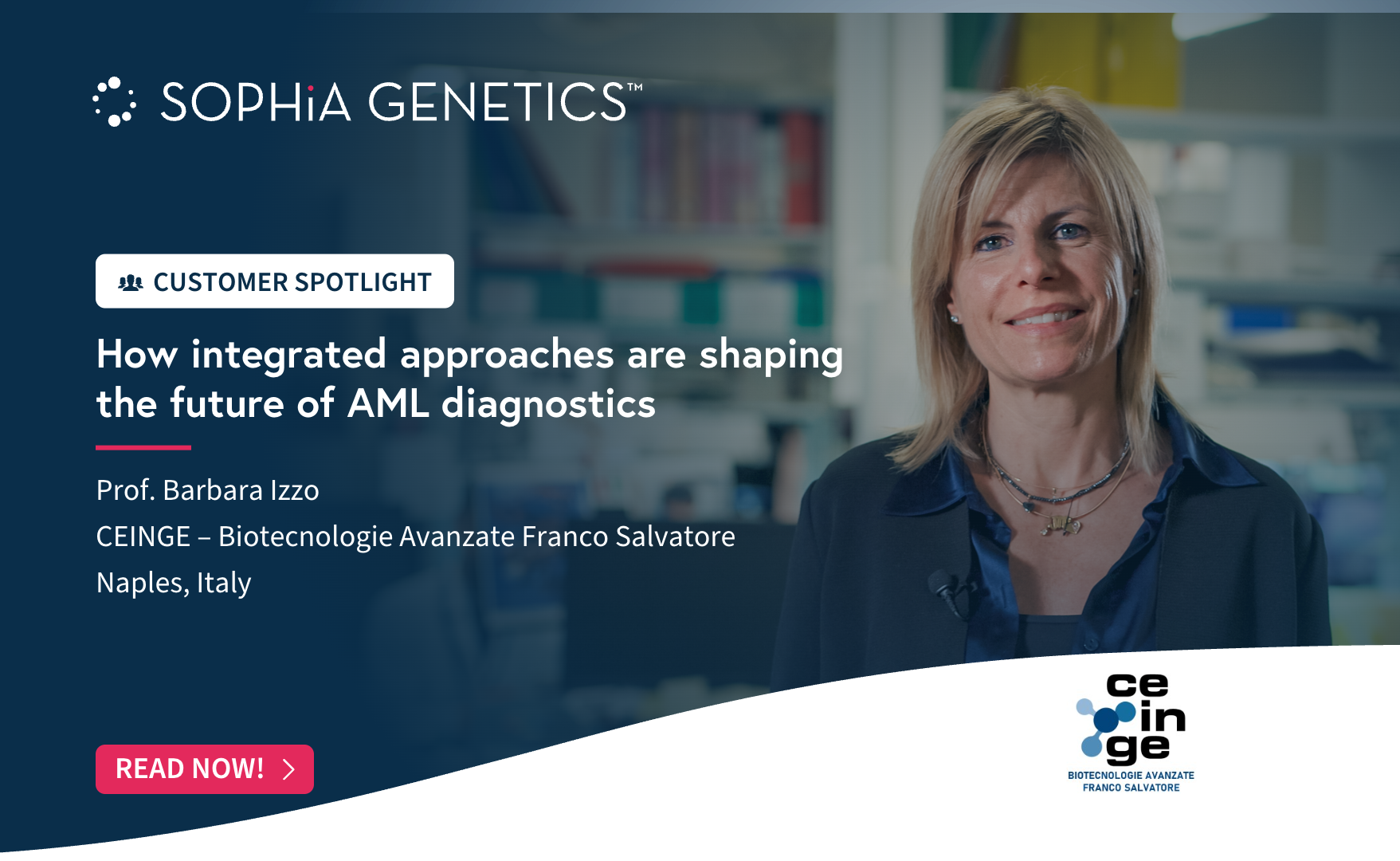
Prof. Barbara Izzo and her team at CEINGE – Biotecnologie Avanzate opened the doors of their laboratory to discuss the growing importance of integrated molecular approaches in the diagnosis of acute myeloid leukemia (AML).
Watch the spotlight:
Could you introduce yourself and your work at CEINGE?
I am Prof. Barbara Izzo, Principal Investigator of the Laboratory of Hematologic Oncology and Cytogenetics at CEINGE. CEINGE is a research and molecular diagnostics center affiliated with the Federico II University Hospital. We operate in the field of molecular diagnostics for both acquired and hereditary genetic diseases.
In particular, the Laboratory of Hematologic Oncology and Cytogenetics serves as a regional and extra-regional referral center for the diagnosis of patients with chronic and acute leukemias, myeloproliferative syndromes, and multiple myeloma.
Every day, bone marrow and peripheral blood samples arrive in our laboratory. From these samples, DNA and RNA are extracted, and based on the patient’s suspected diagnosis, we perform molecular analyses using PCR or, more commonly, NGS. For cytogenetic assessment, we perform karyotyping and FISH to detect specific chromosomal rearrangements.
Over the past five years, we have observed a steady increase in requests for NGS testing. In 2024 alone, we processed approximately 3,000 NGS panel requests. This growth reflects both increased clinical demand and the expansion of the number of NGS panels we offer.
Can you tell us about a particular impactful or challenging case your team has handled recently?
A patient with acute myeloid leukemia was referred to our laboratory for cytogenetic and molecular characterization. Initial karyotyping revealed a deletion on chromosome 11 and additional material on chromosome 12 that could not be clearly identified.
Molecular profiling performed using SOPHiA DDM™ Myeloid Solution, a 30-gene application, identified point mutations in key genes including FLT3, SF3B1, and EZH2. It also confirmed the presence of copy number deletions on chromosomes 11 and 7. Notably, the alteration involving chromosome 7 had not been detected by conventional cytogenetic analysis.
Given these findings, we considered this an ideal case to analyze using the new SOPHiA DDM™ Myeloid Solution v2, which enables the simultaneous detection of mutations, rearrangements, and copy number variations, including deletions and amplifications. The results confirmed monosomy 7, an almost complete deletion of chromosome 11, and additionally identified a partial duplication of chromosome 21.
To further clarify the patient’s cytogenetic and molecular profile, we performed an array CGH analysis, which confirmed monosomy 7, deletion of chromosome 11, and partial duplication of genes on chromosome 21.
To validate these findings, two FISH analyses were conducted. One used probes specific to chromosome 7, confirming monosomy 7. The second clarified the duplication involving chromosome 21, demonstrating that the additional material initially observed on chromosome 12 originated from chromosome 21.
"This comprehensive assessment highlighted the value of a multidisciplinary diagnostic approach combining NGS, cytogenetics, array CGH, and FISH to deliver a complete diagnostic picture for the patient."
How did the SOPHiA DDM™ Myeloid Solution v2 contribute to solving this case?
The introduction of SOPHiA DDM™ Myeloid Solution v2 was particularly impactful, as it enabled earlier detection of copy number variations, deletions, and amplifications compared to cytogenetics alone. It also revealed additional genomic alterations that allowed for more precise patient classification.
"As a result, the patient, initially classified as intermediate risk, was reclassified into an adverse-risk category, directly informing a more targeted therapeutic approach."
This level of insight would not have been achievable using conventional karyotyping alone, which is often limited by technical constraints and longer turnaround times.
The most valuable aspect of this solution is the integration of cytogenetic and molecular profiling. Today, patients with acute myeloid leukemia require timely access to comprehensive genomic information encompassing both cytogenetic rearrangements and molecular mutations. This integrated approach is precisely what the solution delivers.
How does the SOPHiA DDM™ Platform strengthen collaboration and knowledge sharing among the LabNet AMLnetwork, which connects hematologists and labs across Italy?
Within the LabNet AML network, collaboration among laboratories is essential, particularly when it comes to methodologies and reporting practices. The ability to work on a shared analytical platform such as SOPHiA DDM™ is crucial, especially for consistent variant pathogenicity assessment and accurate reporting for each patient.
If you could imagine the future of hemato-oncology research, what excites you the most?
The use of integrated solutions such as SOPHiA DDM™ Myeloid Solution v2 is particularly exciting, as they support the full range of methodological requirements necessary for comprehensive cytogenetic and molecular characterization of patients with acute myeloid leukemia, who require rapid access to targeted therapies.
Looking ahead, the development of solutions that enable a form of molecular karyotyping would represent a major step forward.
"I am confident that continued collaboration between laboratory clinicians and SOPHiA GENETICS will lead to increasingly precise diagnostic solutions, ultimately improving outcomes for patients with hematological malignancies, particularly acute myeloid leukemia."
Interested in learning more about the SOPHiA DDM™ Myeloid Solution v2?
Connect with our team to discover how your laboratory can optimize myeloid malignancy workflows with a comprehensive, efficient sample-to-report solution.
The opinions expressed during the video are those of the speaker and may not represent the opinions of SOPHiA GENETICS.
The patient case presented by the speaker illustrates their experience evaluating the SOPHiA DDM™ Myeloid Solution v2, in line with local regulations.
Any use of SOPHiA GENETICS products described in the video may not have been cleared or approved by Regulatory Authorities.
SOPHiA DDM™ Solutions are For Research Use Only unless otherwise specified.
SOPHiA GENETICS products are for Research Use Only and not for use in diagnostic procedures unless specified otherwise.
SOPHiA DDM™ Dx Hereditary Cancer Solution, SOPHiA DDM™ Dx RNAtarget Oncology Solution and SOPHiA DDM™ Dx Homologous Recombination Deficiency Solution are available as CE-IVD products for In Vitro Diagnostic Use in the European Economic Area (EEA), the United Kingdom and Switzerland. SOPHiA DDM™ Dx Myeloid Solution and SOPHiA DDM™ Dx Solid Tumor Solution are available as CE-IVD products for In Vitro Diagnostic Use in the EEA, the United Kingdom, Switzerland, and Israel. Information about products that may or may not be available in different countries and if applicable, may or may not have received approval or market clearance by a governmental regulatory body for different indications for use. Please contact us to obtain the appropriate product information for your country of residence.
All third-party trademarks listed by SOPHiA GENETICS remain the property of their respective owners. Unless specifically identified as such, SOPHiA GENETICS’ use of third-party trademarks does not indicate any relationship, sponsorship, or endorsement between SOPHiA GENETICS and the owners of these trademarks. Any references by SOPHiA GENETICS to third-party trademarks is to identify the corresponding third-party goods and/or services and shall be considered nominative fair use under the trademark law.