Menu
Menu


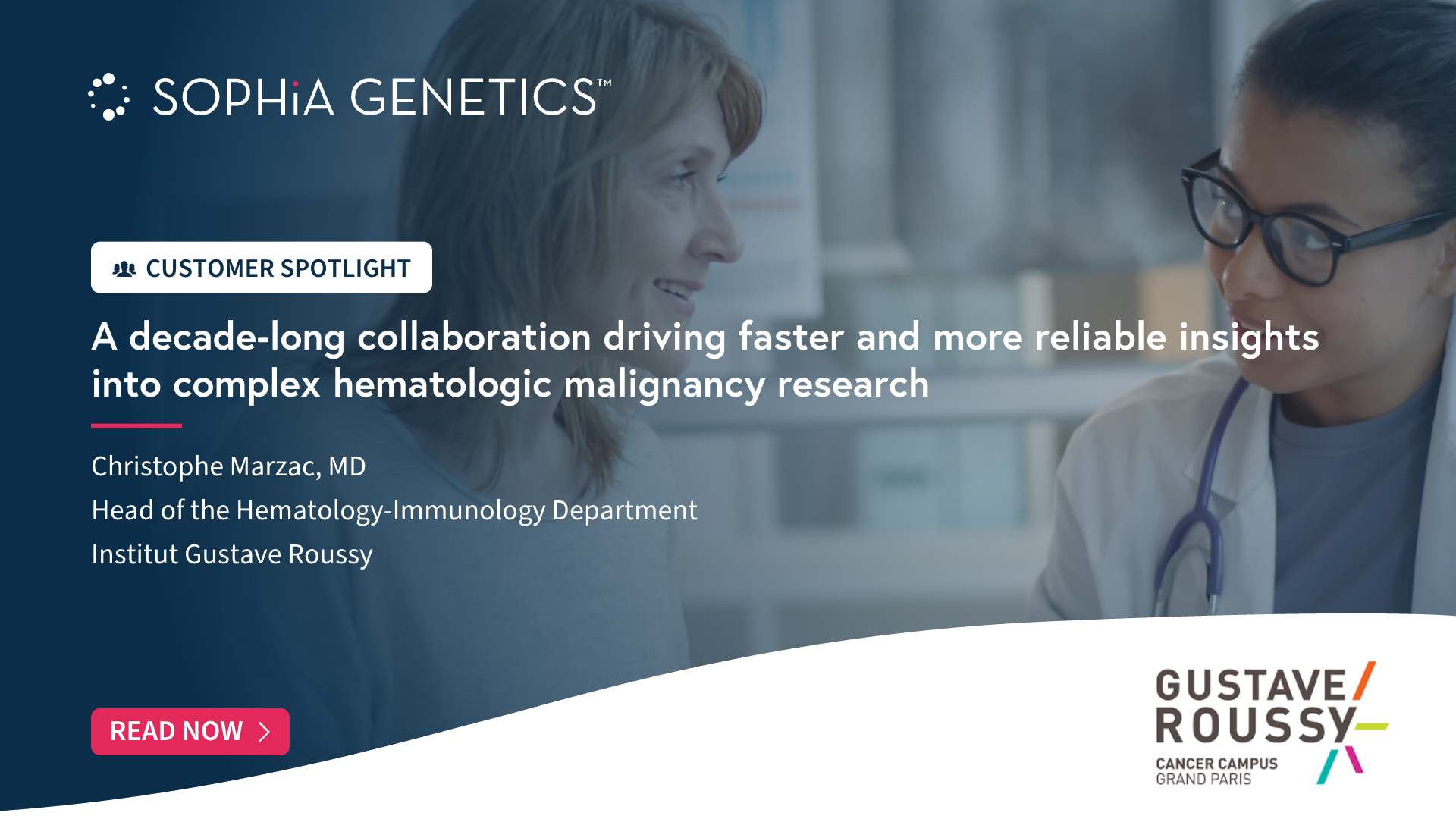
At Gustave Roussy, one of Europe’s leading cancer centers and a global reference in precision oncology, innovation isn’t just a goal, it’s a necessity. Every week, Dr. Christophe Marzac and his team in the Hematology-Immunology Unit manage a high volume of complex cases, many driven by therapy-related mutations and aggressive hematologic malignancies. In this fast-paced environment, rapid, reliable genomic insights are essential for guiding life-saving decisions.
For more than a decade, the team has relied on the SOPHiA DDM™ Platform to support its mission: quickly delivering accurate and meaningful molecular insights. In this spotlight, Dr. Marzac shares how SOPHiA GENETICS helps his team streamline operations by ensuring long-term stability and supporting fast and reliable interpretation.
What’s unique about Gustave Roussy’s approach to hematologic cancer care?
Gustave Roussy is a cancer center, so we only treat patients with solid tumors or hematological malignancies. What really distinguishes us is the high number of therapy-related hematologic malignancies we see. These involve specific mutations, particularly in DNA repair genes such as TP53.
This means that we need to characterize these tumors as precisely as possible. We characterize them at diagnosis, then we follow them during treatment, and depending on the response, we can potentially re-stratify patients based on this minimal residual disease data.
What does your weekly sample-to-insight workflow look like?
We handle around a hundred samples per week. We have one-third dedicated to diagnostic characterization by NGS sequencing, one-third for follow-up of minimal residual disease with dedicated PCR techniques, and then one-third for monitoring post-transplant patients, because, in acute leukemias, bone marrow transplantation remains the only curative treatment for high-risk patients.
What challenges were you trying to address when you first came across SOPHiA GENETICS over a decade ago?
Our biggest challenge was finding a bioinformatics provider. Our laboratories lacked in-house experts, and as biologists, the field was entirely new to us. Eventually, through word of mouth, we ended up discovering SOPHiA GENETICS.
We tested it and saw that we could quite easily get the hang of the platform to interpret our sequencing results. And that was the decisive factor. Since then, we have continued to use it, and we are still just as satisfied.
How has the SOPHiA DDM™ Platform impacted your daily operations?
Compared to what we could develop in-house, because that can also happen, we realized that the SOPHiA DDM™ Platform is both stable and robust. If we want to go through the laboratory accreditation process, we are perfectly compliant. Whereas with our internal solutions, it’s much more complicated. And these solutions are also relatively unstable; they depend on the local bioinformatician who might, one day, decide to move on. So, clearly, we need professional-grade solutions.
What do you value the most about your long-term partnership with SOPHiA GENETICS?
I believe the main added value is stability. Certainly, our techniques have evolved, but we have always found our variants in an extremely reliable way, and quickly as well, because today everything is moving faster and faster. And currently, the ideal turnaround time for acute leukemia is three or four days. This is the time clinicians need to complete the patient’s pre-treatment assessment and for the laboratory to generate all the characterization data so that the best possible therapeutic decision can be made as quickly as possible.
Can you describe how SOPHiA DDM™ helps you interpret results for complex cases?
With each patient, we have new variants to interpret, and it’s extremely easy to do so through the SOPHiA DDM™ interface especially since it retains the pathogenicity flags across all variants in our account. This means that after the 100th or 200th patient analyzed, it becomes extremely quick to determine the pathogenicity of the variants in new patients.
What will shape the future of hemato-oncology in the coming years?
Therapies are evolving rapidly. For acute leukemia, the traditional view was that heavy chemotherapy was the only option. In reality, targeted therapies are now becoming the first-line induction treatment for these patients.
Some patients have theranostic tyrosine kinase mutations for which inhibitors already exist. Others have targetable mutations that lead to epigenetic alterations in the tumor, including mutations in isocitrate dehydrogenase, IDH1 and IDH2.
Ultimately, we are shifting from cytotoxic treatments to differentiation therapies. This means we really need to characterize our tumors as thoroughly as possible, not only in terms of mutational status, but also perhaps in terms of epigenetic profile. And in that context, being able to determine DNA methylation, perhaps through long-read sequencing could be very important for the future.
Interested in learning more about SOPHiA DDM™ for Blood Cancers? Connect with our team to discover how your laboratory can optimize hematologic malignancy workflows with a board portfolio of comprehensive and efficient sample-to-report solutions.
The opinions expressed during the video are those of the speaker and may not represent the opinions of SOPHiA GENETICS.
Any use of SOPHiA GENETICS products described in the video may not have been cleared or approved by Regulatory Authorities.
SOPHiA DDM™ Solutions are For Research Use Only unless otherwise specified.
SOPHiA GENETICS products are for Research Use Only and not for use in diagnostic procedures unless specified otherwise.
SOPHiA DDM™ Dx Hereditary Cancer Solution, SOPHiA DDM™ Dx RNAtarget Oncology Solution and SOPHiA DDM™ Dx Homologous Recombination Deficiency Solution are available as CE-IVD products for In Vitro Diagnostic Use in the European Economic Area (EEA), the United Kingdom and Switzerland. SOPHiA DDM™ Dx Myeloid Solution and SOPHiA DDM™ Dx Solid Tumor Solution are available as CE-IVD products for In Vitro Diagnostic Use in the EEA, the United Kingdom, Switzerland, and Israel. Information about products that may or may not be available in different countries and if applicable, may or may not have received approval or market clearance by a governmental regulatory body for different indications for use. Please contact us to obtain the appropriate product information for your country of residence.
All third-party trademarks listed by SOPHiA GENETICS remain the property of their respective owners. Unless specifically identified as such, SOPHiA GENETICS’ use of third-party trademarks does not indicate any relationship, sponsorship, or endorsement between SOPHiA GENETICS and the owners of these trademarks. Any references by SOPHiA GENETICS to third-party trademarks is to identify the corresponding third-party goods and/or services and shall be considered nominative fair use under the trademark law.