
Menu
Menu
Explore how integrating tissue and liquid biopsies reveals a fuller molecular picture and strengthens precision oncology strategies.

SOPHiA GENETICS and Myriad Genetics have joined forces to create a unique hybrid CDx model designed for improved efficiency and scalability. Listen to this podcast to explore this groundbreaking partnership.
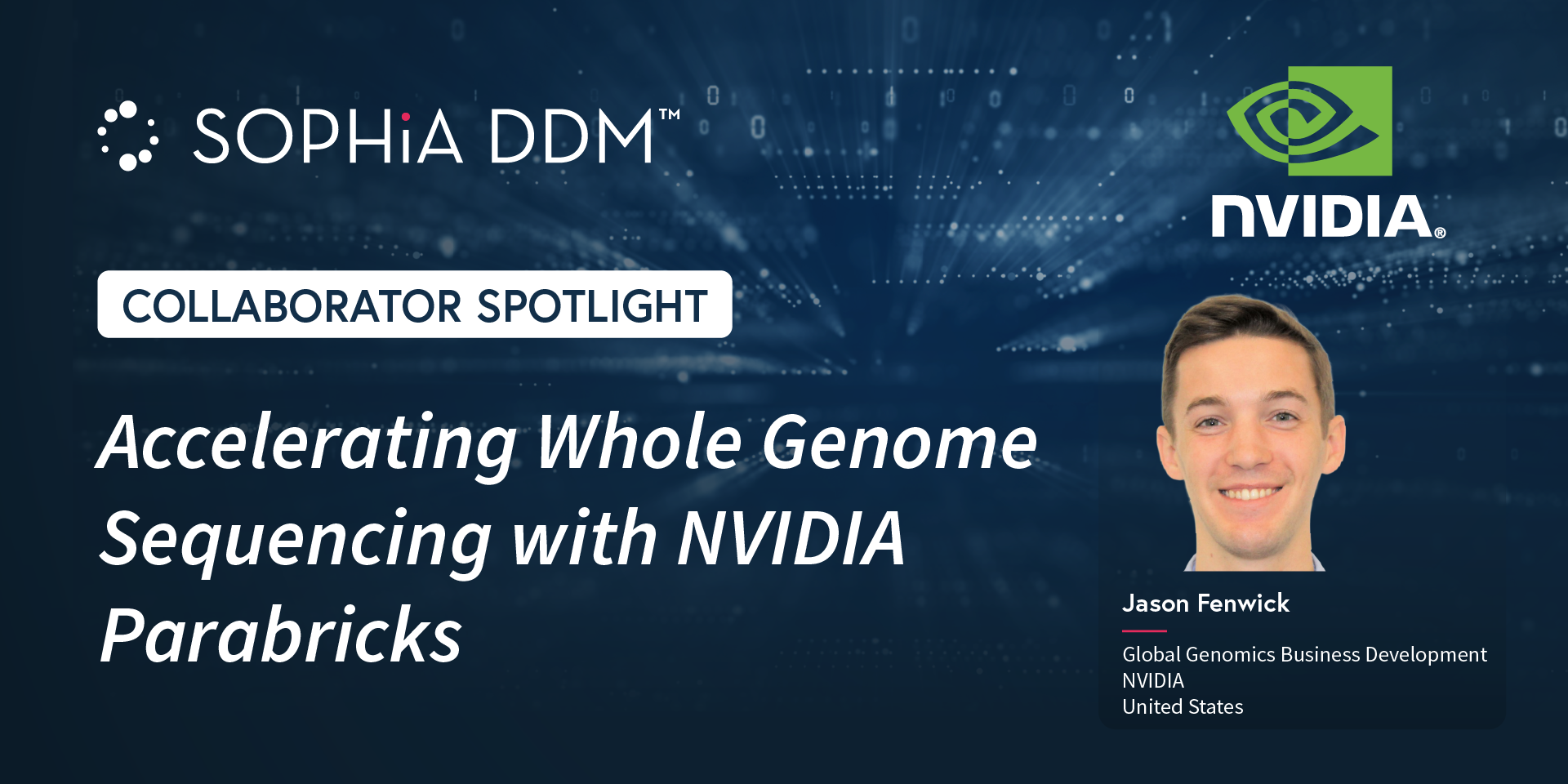
We spoke with Jason Fenwick at NVIDIA to explore how graphics processing unit (GPU) acceleration is addressing key computational bottlenecks in clinical whole genome sequencing (WGS). The discussion focuses on NVIDIA Parabricks, a GPU-accelerated secondary analysis solution, and its integration into SOPHiA DDM™ for WGS. Jason explains how accelerated alignment and variant calling can significantly reduce analysis time while maintaining the accuracy and reliability required for clinical genomics workflows.

Precision oncology is reshaping cancer care, with genomics increasingly guiding diagnosis and therapeutic decisions. At the heart of this transformation are companion diagnostics (CDx), essential tools to ensure patients receive the right treatment at the right time. However, despite remarkable scientific advances, pharmaceutical companies continue facing a persistent challenge: how to bring precision therapies to market faster while ensuring efficiency, accuracy, and broad patient access?
To meet these demands, CDx pathways must evolve. They must align with regulatory requirements, offer short turnaround times (TAT) from development to commercialization, scale effectively, and guarantee equitable access worldwide.

Acute myeloid leukemia (AML) remains one of the most genomically complex hematologic malignancies. As new biomarkers and targeted therapies continue to reshape disease classification, next-generation sequencing (NGS) plays an increasingly central role in diagnosis, prognosis, and treatment selection. In this article, adapted from Dr. Hubert Tsui’s presentation at a recent webinar, we explore how NGS fits within the AML patient journey, from first evaluation to meaningful insights.

Gene fusions are key drivers in many myeloid malignancies. As our understanding of these complex events has evolved, so too have the technologies designed to detect them. This blog explores how SOPHiA DDM™ leverages advanced DNA-based workflows to enhance the efficiency of fusion detection, helping labs move faster from sample to insight.

In today’s fast-moving biopharma landscape, companies face increasing pressure to deliver the right treatment, to the right patient, at the right time and in the right sequence, faster and more efficiently. As our understanding of disease biology complexity grows and the need for targeted therapies further intensifies, legacy R&D models are increasingly strained in the quest to deliver timely and impactful innovations.

Discover expert insights on the evolving role of exome and genome sequencing in clinical diagnostics. Learn how virtual panels, reimbursement trends, and technical advancements are shaping genomic medicine.

More than six people die every hour in the US from a blood cancer. Solutions can’t come fast enough for those who suffer with these cancers all around the world. Fortunately, researchers studying blood diseases have experienced rapid advances in their capabilities to develop and test effective therapies with some extremely significant advancements.

Clinical trials are the backbone of modern medicine, responsible for bringing innovative, safe, and efficient treatments to market after rigorous testing and evaluation. However, the conventional process of conducting these trials has often been long, expensive, and fraught with inefficiencies¹. The advent of predictive analytics is reshaping the landscape of clinical trials, ushering in a new era of precision efficiency². This blog explores how predictive analytics is transforming clinical trials, from optimizing design and recruitment to predicting outcomes and reducing risks.
SOPHiA GENETICS products are for Research Use Only and not for use in diagnostic procedures unless specified otherwise.
SOPHiA DDM™ Dx Hereditary Cancer Solution, SOPHiA DDM™ Dx RNAtarget Oncology Solution and SOPHiA DDM™ Dx Homologous Recombination Deficiency Solution are available as CE-IVD products for In Vitro Diagnostic Use in the European Economic Area (EEA), the United Kingdom and Switzerland. SOPHiA DDM™ Dx Myeloid Solution and SOPHiA DDM™ Dx Solid Tumor Solution are available as CE-IVD products for In Vitro Diagnostic Use in the EEA, the United Kingdom, Switzerland, and Israel. Information about products that may or may not be available in different countries and if applicable, may or may not have received approval or market clearance by a governmental regulatory body for different indications for use. Please contact us to obtain the appropriate product information for your country of residence.
All third-party trademarks listed by SOPHiA GENETICS remain the property of their respective owners. Unless specifically identified as such, SOPHiA GENETICS’ use of third-party trademarks does not indicate any relationship, sponsorship, or endorsement between SOPHiA GENETICS and the owners of these trademarks. Any references by SOPHiA GENETICS to third-party trademarks is to identify the corresponding third-party goods and/or services and shall be considered nominative fair use under the trademark law.