Menu
Menu


Pharmacogenetics is moving from a specialized testing approach toward an increasingly integrated part of precision medicine. In this User Spotlight, Prof. Nicolas Picard, Head of the French-speaking network of Pharmacogenetics (RNPGx) at Limoges University Hospital, France, discusses the evolution of pharmacogenomics in clinical practice, the importance of collaboration between clinical experts and technology innovators, and the role of NGS in enabling more pre-emptive and personalized decisions. He also reflects on the long-standing collaboration between RNPGx and SOPHiA GENETICS and the future of pharmacogenomics across France and Europe.
SG: Can you introduce the French National Network of Pharmacogenetics (RNPGx) and its role in advancing pharmacogenetics in Europe?
NP: The RNPGx is a network bringing together hospital-based experts in pharmacogenetics from France and other French-speaking countries, including Belgium, Switzerland, Tunisia and Canada. Our objective is to promote the development, harmonization and, most importantly, the clinical implementation of pharmacogenetics.
A major part of our role is to support regulatory and health authorities in defining which genetic markers are clinically relevant, how they should be tested, and how testing can be reimbursed in a rational and evidence-based way.
SG: How do you see pharmacogenetics contributing to safer, more personalized medicine today?
NP: For me, the value of pharmacogenetics is very practical: it gives us additional information before or during treatment to identify patients who may be at increased risk of toxicity, patients who may require a different dose, or patients for whom an alternative drug may be more appropriate. Medicine has historically relied heavily on population averages. Pharmacogenetics adds another layer of individual information and helps us move toward selecting the right drug and the right dose for a particular patient.
SG: When did your collaboration with SOPHiA GENETICS begin, and what initially brought our teams together?
NP: Our collaboration began in 2017 at a time when we were looking at how next-generation sequencing could be applied more to pharmacogenetics. What brought the teams together was a very complementary set of needs and expertise. On the RNPGx side, we had strong expertise in pharmacogenetics and a clear understanding of the genes, variants and technical challenges that matter in routine practice. SOPHiA GENETICS brought expertise in NGS technology and very importantly in bioinformatics.
SG: From the beginning, how important was co-development versus adopting an off-the-shelf solution and how would you describe the collaborative process behind developing the pharmacogenomics panel together?
NP: Co-development was very important. Pharmacogenetics has some particular technical challenges, and a generic sequencing solution does not necessarily address them adequately. Certain pharmacogenes are technically complex, and clinical relevance is also critical: we need to know that the relevant variants are covered.
The collaboration therefore involved continuous exchanges with the SOPHiA GENETICS teams. RNPGx could provide input on clinical priorities, genes and variants of interest, while SOPHiA GENETICS could translate these requirements into a sequencing and analytical approach.
“Co-development was very important. Pharmacogenetics has some particular technical challenges, and a generic sequencing solution does not necessarily address them adequately. Certain pharmacogenes are technically complex, and clinical relevance is also critical: we need to know that the relevant variants are covered.”
SG: How did clinical expertise from RNPGx and technological expertise from SOPHiA GENETICS complement each other during development?
NP: The complementarity was quite natural. RNPGx experts understand what is clinically actionable and where the difficulties are when pharmacogenetic testing is performed in real-life hospital laboratories.
SOPHiA GENETICS, on the other hand, brought the technological and bioinformatics expertise required to transform those requirements into an NGS-based solution.
SG: What were some key milestones or learnings during this multi-year collaboration?
NP: One important learning has been that developing pharmacogenomics solutions is an iterative process. The scientific knowledge evolves, recommendations evolve, and the technical capabilities of sequencing and bioinformatics also evolve.
SG: How has the solution evolved over time to reflect advances in science and clinical practice?
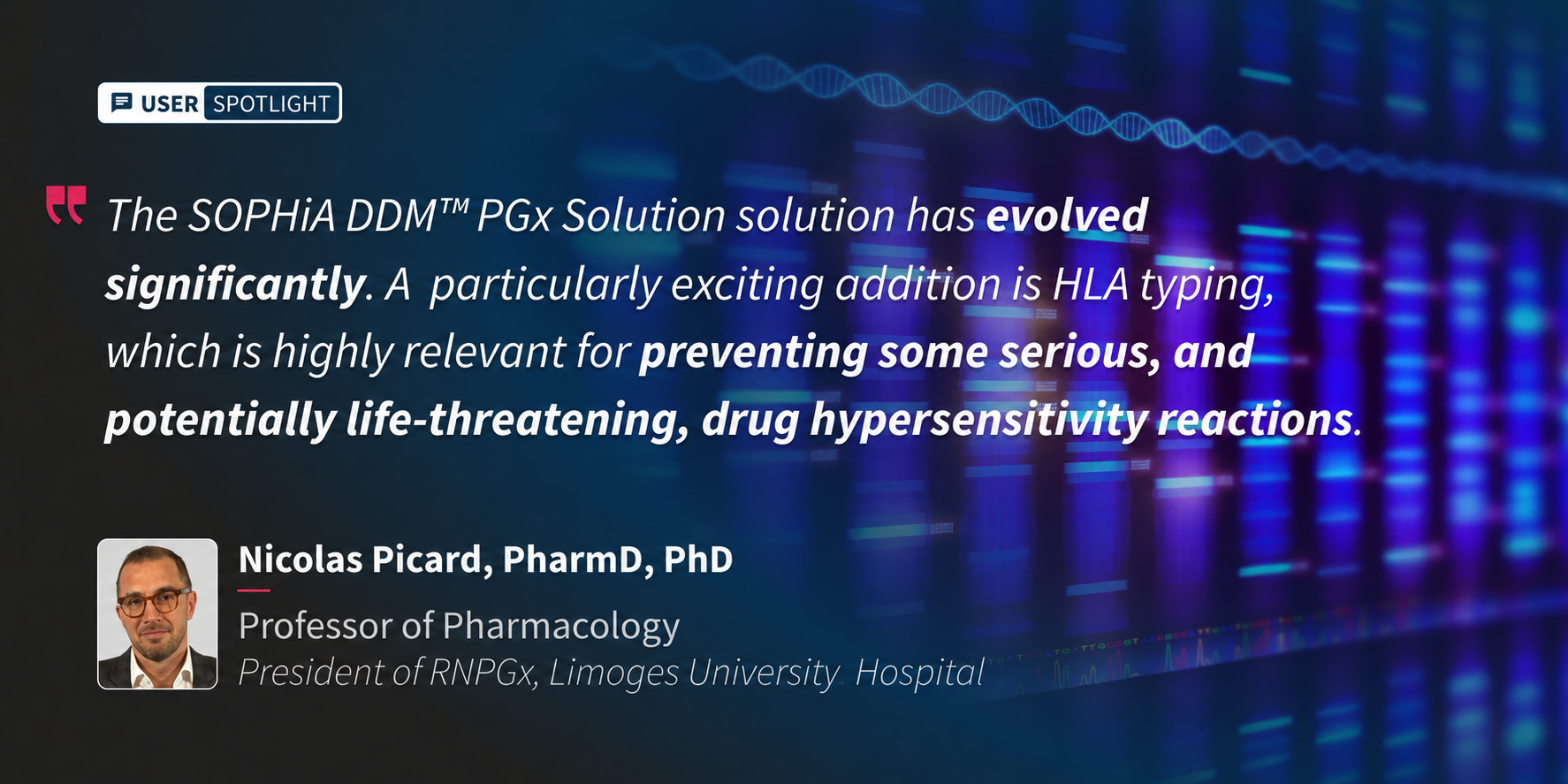
NP: The solution has evolved both from a technological and a clinical insight. One important step was the addition of Star Anise, a star allele calling module. This was particularly important for pharmacogenomics, where translating genetic variation into clinically meaningful haplotypes and metabolizer phenotypes can be complex. More recently, we reviewed the content of the panel to ensure that it better reflects current needs, based in particular on recommendations published by the RNPGx. A particularly exciting addition is HLA typing, which we had been eagerly awaiting. HLA is highly relevant for preventing some serious, and potentially life-threatening, drug hypersensitivity reactions.
“A particularly exciting addition is HLA typing, which we had been eagerly awaiting. HLA is highly relevant for preventing some serious, and potentially life-threatening, drug hypersensitivity reactions.”
SG: Can you share practical examples where pharmacogenomics helped prevent serious adverse drug reactions? How has NGS-based pharmacogenetics changed drug selection or dosing decisions in routine care?
NP: There are several very concrete situations in which pharmacogenetics can directly influence treatment decisions. HLA is a particularly good example, as specific HLA alleles are strongly associated with serious, and potentially life-threatening, cutaneous or hypersensitivity reactions to certain drugs. Another well-known example is DPYD and fluoropyrimidine chemotherapy. Patients with reduced DPD activity can be at substantially increased risk of severe, potentially lethal toxicity. In France, we primarily rely on DPD enzyme phenotyping to identify patients at risk before treatment. However, the complementary use of NGS is highly valuable, particularly because it can identify rare DPYD variants that may not be captured by more targeted genotyping approaches.
We also have important applications in other therapeutic areas, particularly psychiatry, where metabolizer status can significantly influence drug exposure and may help inform dose adjustment or the choice of treatment. This is where NGS becomes particularly interesting. It allows us to move beyond a succession of individual tests performed in response to individual prescriptions. With a panel-based approach, we can obtain information on multiple pharmacogenes simultaneously. This opens the way to a more pre-emptive model of pharmacogenetics, where information generated once can potentially be reused throughout the patient's care as different treatments are considered.
“For me, this is one of the major changes brought by NGS: pharmacogenetics is no longer limited to answering one question about one drug at one point in time.”
SG: Looking back, how would you describe the evolution of your partnership with SOPHiA GENETICS? In addition, how do you feel RNPGx has contributed to shaping SOPHiA GENETICS’ pharmacogenomics offerings?
NP: I would describe the partnership as an evolution from an initial technological collaboration toward a broader exchange between clinical needs and technological development.
RNPGx has been able to contribute the perspective of hospital laboratories who are actually using pharmacogenetics. This means answering very practical questions: Which genes are important? Which variants must be covered? What technical limitations could affect a clinical decision? Clinical practice helps shape the technology, while technological innovation expands what we can envisage clinically!
SG: What role do you see pharmacogenetics playing in the future of precision medicine in France and across Europe?
NP: I believe pharmacogenetics will progressively become a routine component of precision medicine. The question is increasingly not whether pharmacogenetics has clinical value, because for a growing number of gene–drug pairs the evidence is already strong. The challenge is how to implement it at scale. Ultimately, I see pharmacogenetic information becoming part of a patient's medical information and being available when a prescribing decision is made, rather than having to order a new test every time a relevant drug is considered.
SG: How do you envision this collaboration evolving over the coming years?
“The next stage is to continue bridging the gap between technological capability and routine implementation.”
This means thinking beyond the laboratory itself. The major challenge is how pharmacogenomic insights reach the clinician at the right moment to support future patient healthcare decisions
I therefore see opportunities to continue working together not only on analytical performance, but also on the broader integration of pharmacogenomics into clinical pathways.
SG: What excites you most about the next phase of pharmacogenomics innovation?
NP: What excites me most is the transition from pharmacogenetics as a specialized test to pharmacogenomics as information that can accompany the patient over time.
Today, testing is still often triggered by a particular prescription. In the future, we can imagine a more pre-emptive model: pharmacogenomic information is generated once, stored appropriately, and then used whenever a relevant treatment is considered.
The real innovation will be connecting high-quality genomic information with clinical decision support so that the right information appears at the right moment for the prescriber.
Thank you, Nicolas. We would like to thank Nicolas Picard for sharing his perspective on the evolution of pharmacogenomics, the importance of collaboration between clinical expertise and technology, and the opportunities ahead for integrating pharmacogenomic information into routine patient care. His insights highlight how continued innovation and collaboration can help bring more personalized, evidence-based treatment decisions into everyday clinical practice across Europe.
SOPHiA GENETICS products are for Research Use Only and not for use in diagnostic procedures unless specified otherwise.
SOPHiA DDM™ Dx Hereditary Cancer Solution, SOPHiA DDM™ Dx RNAtarget Oncology Solution and SOPHiA DDM™ Dx Homologous Recombination Deficiency Solution are available as CE-IVD products for In Vitro Diagnostic Use in the European Economic Area (EEA), the United Kingdom and Switzerland. SOPHiA DDM™ Dx Myeloid Solution and SOPHiA DDM™ Dx Solid Tumor Solution are available as CE-IVD products for In Vitro Diagnostic Use in the EEA, the United Kingdom, Switzerland, and Israel. Information about products that may or may not be available in different countries and if applicable, may or may not have received approval or market clearance by a governmental regulatory body for different indications for use. Please contact us to obtain the appropriate product information for your country of residence.
All third-party trademarks listed by SOPHiA GENETICS remain the property of their respective owners. Unless specifically identified as such, SOPHiA GENETICS’ use of third-party trademarks does not indicate any relationship, sponsorship, or endorsement between SOPHiA GENETICS and the owners of these trademarks. Any references by SOPHiA GENETICS to third-party trademarks is to identify the corresponding third-party goods and/or services and shall be considered nominative fair use under the trademark law.