Menu
Menu


Context & Study Overview
Lung cancer remains one of the most common cancers worldwide, of which non-small cell lung cancer (NSCLC) represents approximately 85% of all cases. Immunotherapies targeting the PD-L1/PD-1 pathway, alone or combined with chemotherapy and/or other immune checkpoint inhibitors (ICI), have transformed outcomes for many patients with metastatic NSCLC.
However, not every patient benefits equally, highlighting the need to better identify subsets of patients who are most likely to respond positively.
The phase III POSEIDON trial (NCT03164616) indicated that adding tremelimumab (T), to durvalumab (D) and chemotherapy (CT) significantly improved overall survival (OS) (HR=0.77, 95% CI: 0.65-0.92; P=0.0030) compared with CT alone, leading to its approval as a first-line (1L) treatment for metastatic NSCLC patients without EGFR or ALK targeted mutations. A post-hoc analysis of this trial data further suggested that patients with KRAS, STK11, or KEAP1 mutations, genes usually associated with a poorer prognosis, may see a benefit from this three-drug combination.
Building on these findings, the TRIDENT study utilized machine learning (ML) to develop a multimodal predictive model, combining multiple types of data modalities to identify subgroups of patients who may benefit most from adding T to 1L D and CT.
Dataset and Methods
The TRIDENT study is a retrospective analysis of the POSEIDON trial (data cut-off: 12 March 2021), combining clinical, genomic, and radiomics data collected at baseline.
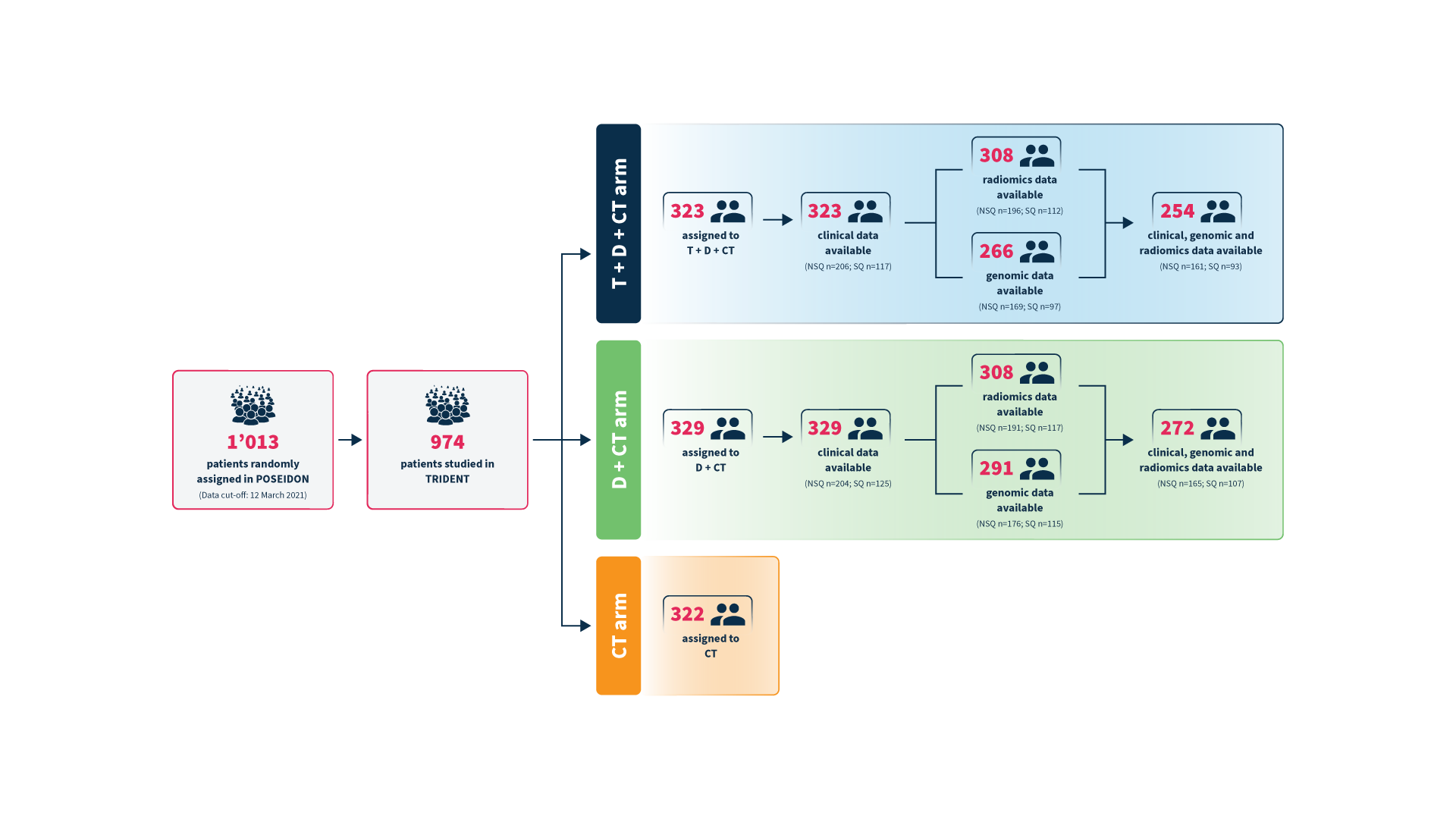
Of the 1’013 patients originally randomized in the POSEIDON trial, 974 were included in the TRIDENT study. Of these, 652 patients (323 in the T + D + CT arm; 329 in the D + CT arm) were included in an intention-to-treat (ITT) analysis. Depending on data availability, different analysis sets were built (Figure 1).
A series of ML models were trained, testing different combinations of data (clinical alone, clinical plus radiomics, clinical plus genomics, and clinical, radiomics, and genomic data) to estimate each patient’s individual expected benefit, based on the conditional average treatment effect (CATE) value. For each patient, the model estimated how many additional months of survival they might gain from adding T, based on their own clinical, genomic, and radiomics profile.
Model performance was assessed using a stratified nested cross-validation (NCV) to prevent overfitting and ensure a fair evaluation, given the small sample sizes. A permutation-based feature importance analysis was then used to identify which patient characteristics most influenced the model’s predictions.
Key Findings
The developed ML models successfully identified subgroups of patients with a significantly greater overall survival (OS) benefit from adding T, particularly when genomic data was included, and especially among patients with non-squamous histology.
Table 1. Summary of nested cross-validation results for the three models able to identify a subpopulation of patients with a relative risk reduction of OS.
| Model | Data modalities | Sample size | Histology type | HR for all patients (95% CI) | HR for top 50%* (95% CI) | HR for top 30%* (95% CI) | Top predictive features |
|---|---|---|---|---|---|---|---|
| Model 4 | Clinical + Radiomics | 616 | All histologies | 0.88 (0.73-1.05) | 0.75 (0.58-0.98) P=0.04 | 0.75 (0.55-1.02) P=0.07 | NLR; imaging features (tumor intensity, volume, shape) |
| Model 7 | Clinical + Genomics | 557 | All histologies | 0.78 (0.18-1.37) | 0.75 (0.57-0.97) P=0.03 | 0.63 (0.44-0.91) P=0.01 | albumin, NLR, EGFR, SMO, FGFR3 |
| Model 19 | Clinical + Genomics | 345 | Non-squamous | 0.88 (0.68-1.12) | 0.56 (0.33-0.97) P=0.04 | 0.48 (0.24-0.95) P=0.04 | EGFR, FGFR3, CDKN2A, KRAS, STK11 |
*HR for top 50% or 30% refers to the estimated hazard ratio for the 50% or 30% of patients with the highest predicted benefit from the addition of T to D and CT.
NLR, Neutrophil lymphocyte ratio
As such, across all histology types, the patients who may derive greater OS benefit from the addition of 1L T to D and CT are significantly more likely to have non-squamous NSCLC linked with EGFR wild-type, FGFR3 wild-type, CDKN2A wild-type, KRAS mutation, and STK11 mutation.
Due to the retrospective nature of the data and the unavailability of an independent validation cohort, these results are hypothesis-generating. The reported performance should be interpreted as an internally validated estimate rather than confirmed evidence of clinical predictive accuracy.
Conclusion and Clinical Implications
TRIDENT shows that combining multiple types of patient data, specifically clinical and genomic data, with ML can help identify which patients with metastatic NSCLC would be likely to gain the most survival benefit from adding T to D and CT. This was especially clear in non-squamous NSCLC, where a distinct genomic signature differentiated higher- from lower-benefit patients.
These findings reinforce the value of a multimodal approach in improving patient selection both in research and in clinical settings, namely in providing support to the ongoing phase 3b TRITON trial (NCT06008093), which is prospectively evaluating T plus D and chemotherapy in patients with metastatic NSCLC and STK11, KEAP1, or KRAS mutations.
Future analyses like assessing the predictive value of co-mutations, such as KRAS with STK11 and/or KEAP1, where previous studies have shown a potentially greatest benefit by the addition of T, should also be considered.
While prospective external validation is still needed, the TRIDENT study offers an example of how ML could support smarter patient selection for clinical trials today and for personalized treatment decisions in the future.
Explore this infographic to learn more about this project and the predictive model developed by Skoulidis F. et al’s.
Skoulidis F, et al. Clin Cancer Res. 2026. Doi: 10.1158/1078-0432.CCR-25-3729
Disclaimer
This project was executed by SOPHiA GENETICS in collaboration with AstraZeneca, using data from the POSEIDON trial (NCT03164616).
The study team leveraged the SOPHiA DDM™ for Multimodal factory and its proprietary algorithms to perform this retrospective data analysis. If you want to know more about SOPHiA DDM™ for Multimodal, please visit our dedicated webpage (www.sophiagenetics.com/sophia-ddm-for-multimodal/).
SOPHiA DDM™ for Multimodal is for Research Use Only. May not be available for sale.
SOPHiA GENETICS products are for Research Use Only and not for use in diagnostic procedures unless specified otherwise.
SOPHiA DDM™ Dx Hereditary Cancer Solution, SOPHiA DDM™ Dx RNAtarget Oncology Solution and SOPHiA DDM™ Dx Homologous Recombination Deficiency Solution are available as CE-IVD products for In Vitro Diagnostic Use in the European Economic Area (EEA), the United Kingdom and Switzerland. SOPHiA DDM™ Dx Myeloid Solution and SOPHiA DDM™ Dx Solid Tumor Solution are available as CE-IVD products for In Vitro Diagnostic Use in the EEA, the United Kingdom, Switzerland, and Israel. Information about products that may or may not be available in different countries and if applicable, may or may not have received approval or market clearance by a governmental regulatory body for different indications for use. Please contact us to obtain the appropriate product information for your country of residence.
All third-party trademarks listed by SOPHiA GENETICS remain the property of their respective owners. Unless specifically identified as such, SOPHiA GENETICS’ use of third-party trademarks does not indicate any relationship, sponsorship, or endorsement between SOPHiA GENETICS and the owners of these trademarks. Any references by SOPHiA GENETICS to third-party trademarks is to identify the corresponding third-party goods and/or services and shall be considered nominative fair use under the trademark law.